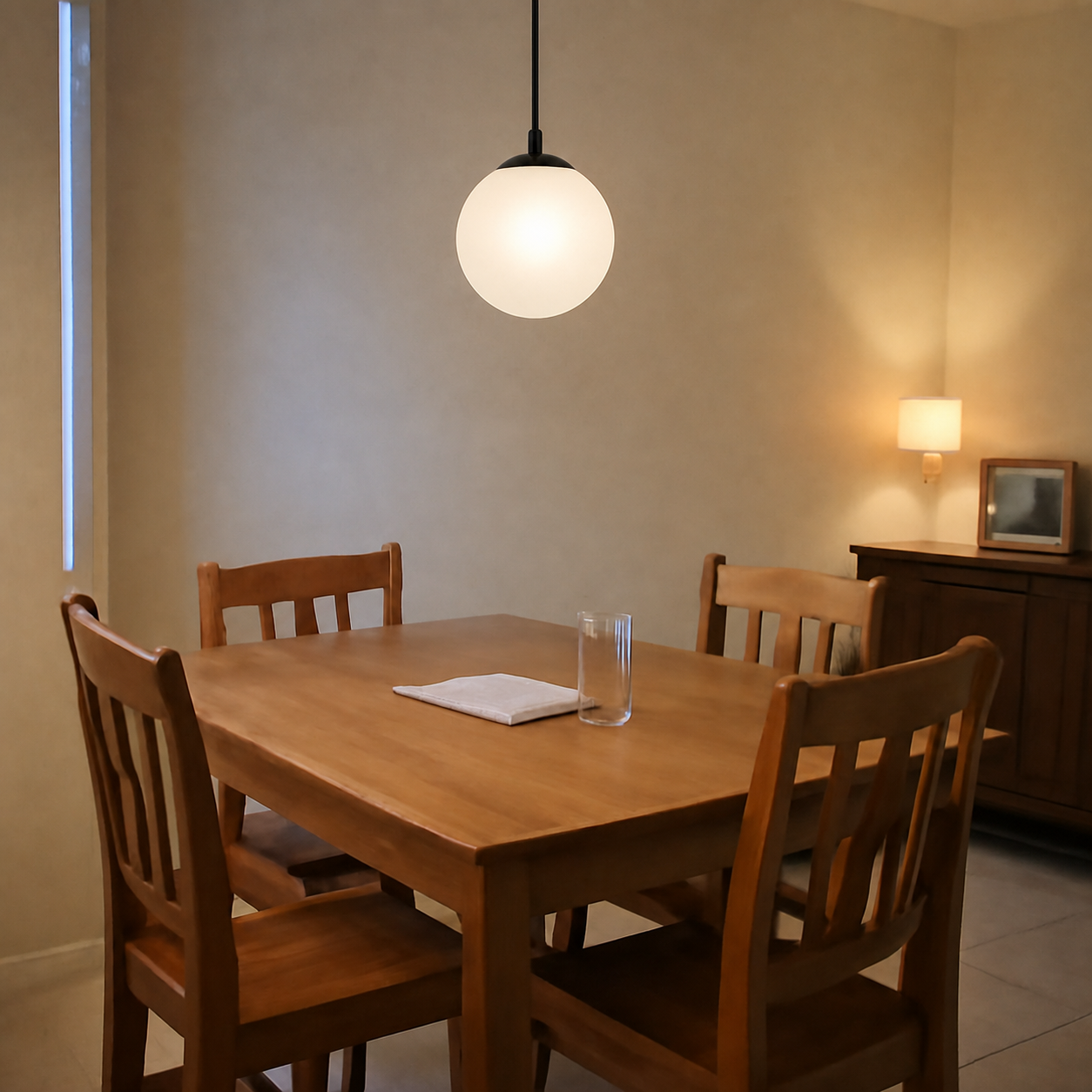
A pendant over a dining table should be roughly the table's width minus 12 inches (30 cm), hung so the bottom of the fixture sits 30–36 inches (76–91 cm) above the tabletop. For long rectangular tables, use two or three smaller pendants spaced evenly — one fixture per 30–36 inches of table length. Pick a bulb at 2700K for warm dining light, 800–1000 lumens per seat. Get the size, the height, and the colour temperature right and the room transforms without anyone naming why.
How big should the pendant be?
Pendant width should be the table's narrower dimension minus 12 inches. The 12-inch margin keeps the fixture from feeling over-sized when you walk past, and prevents anyone seated at the end of the table from hitting their head leaning forward.
For a single pendant, the largest dimension also matters — on a long table, a single round fixture that's right for the width still leaves the ends of the table dark. Long tables want long fixtures (a linear pendant) or multiple smaller ones.
Pendant sizing by table size
| Table size | Seats | Single pendant | Cluster / linear |
|---|---|---|---|
| 36 in round | 4 | 20–24 in wide | Single is best |
| 48 in round | 4–6 | 28–36 in wide | 3 small pendants in a cluster |
| 60 in × 36 in | 6 | 24 in (centred) | 2 pendants, 12–14 in each |
| 72 in × 38 in | 6–8 | Linear 48–54 in | 3 pendants, 10–12 in each |
| 96 in × 40 in | 8–10 | Linear 60–72 in | 3 pendants, 14–16 in each |
How high should the pendant hang?
The bottom of the fixture should be 30–36 inches (76–91 cm) above the tabletop. Three numbers in the range, each with a reason:
- 30 inches: tight rooms, lower ceilings, intimate dining light. The pendant reads “part of the table.”
- 32–34 inches: the safe default. People standing on either side of the table don't hit the fixture; seated people see across without it blocking eye contact.
- 36 inches: high-ceiling rooms (10 ft+). Goes higher only if you add an inch per foot of ceiling above 8 ft.
Measure from the tabletop to the bottom of the shade or the lowest visible bulb — not to the ceiling rose or to the top of the fixture. Catalogs sometimes list overall fixture height instead, which leads to fixtures hung 3–4 inches too low.
Should you pick a single fixture or multiple?
Three rules cover most decisions:
- Round tables get a single fixture. Centred over the table, sized to (diameter − 12 in). Visual weight matches the table's form.
- Rectangular under 60 in gets a single fixture. A drum or globe pendant works; pick width = narrowest table dimension − 12 in.
- Rectangular 60 in+ gets multiples or a linear. One fixture per 30–36 in of table length, or a linear chandelier that spans about two-thirds of the table.
How to space a cluster or pendant row
Spacing matters as much as count. A row of three pendants over a 72-inch table:
- Centre the middle pendant on the centre of the table.
- Space the outer two so they sit roughly 12 inches in from each end of the table — not flush with the table ends.
- For a cluster of three over a round table, hang at staggered heights — 3–4 inch difference between the highest and lowest. Reads sculptural, not lined up.
Key takeaway
Two pendants over a long table is the most common mistake — the middle of the table reads dark, and the centre of the visual composition lands awkwardly between the fixtures. Either go to one linear fixture or three pendants.
What bulb temperature should you use for dining light?
Use 2700K (“warm white”) for dining. Skin tones look natural, food looks appetising, and the room reads relaxed. 3000K is fine if everything else in the room is also 3000K, but mixed colour temperatures clash.
- 2200K “amber”: cosy, atmospheric, slightly dim. Good for vintage Edison-style bulbs in a decorative fixture.
- 2700K “warm white”: the default for dining. Modern enough to read clean; warm enough to flatter food.
- 3000K “soft white”: crisper. Pairs with white kitchens and minimalist palettes; can read too cool in warm-wood rooms.
- 4000K+ “daylight”: avoid over dining tables. Reads clinical.
How many lumens do you need?
Aim for 800–1000 lumens of pendant light per seat at the table. Distribute across the number of pendants you've chosen.
- 4-seat round table: a single 800–1200 lumen bulb (an 8–13 W LED).
- 6-seat rectangular: 2–3 pendants, each 600–800 lumens.
- 8-seat or more: linear pendant with 3–5 bulbs, total 4000–6000 lumens.
Always put the pendant on a dimmer. Dinner-party lighting is about 30–50% of maximum; reading a recipe at the table wants 100%. A single $20 dimmer switch is the highest-leverage upgrade in the room.
Common pendant-lighting mistakes
- Hanging too high. The fixture floats away from the table and stops feeling like dining light. 30–36 inches above the tabletop is the range; anything over 40 inches reads disconnected.
- Picking a pendant the same width as the table. The 12-inch margin matters. A 36-inch pendant over a 36-inch table looks pasted on.
- Two pendants over a long table. One or three. Two leaves the centre dark and the visual centre unmoored.
- Skipping the dimmer. Bright bare bulbs over a dinner table is unforgiving lighting — for the food and for the people. Even the cheapest dimmer fixes this.
- Mixing colour temperatures. A 2700K pendant under a 4000K ceiling fixture reads as two different rooms. Match the temperature across the ceiling and pendants, or run separate switches.
Confirming the pendant before installation
Pendants are hard to return once the electrician has wired them in. Two quick checks before you finalise the order:
- 1Mark the fixture's width on the table with two strips of painter's tape. Mark the hanging height by holding a flashlight at the intended bottom of the fixture. Stand at the table; walk around it.
- 2Preview the actual fixture in a photo of your dining room. See a pendant-and-dining-table preview to gauge what the proportion reads like before the electrician arrives. Drop the product image into a lighting visualizer to see the finish against your specific wall paint and cabinetry.
For more on coordinating across the whole room, see how to design a room around one statement piece — a pendant is often the best anchor in a dining space — or how realistic AI room previews actually are if you've never previewed before.