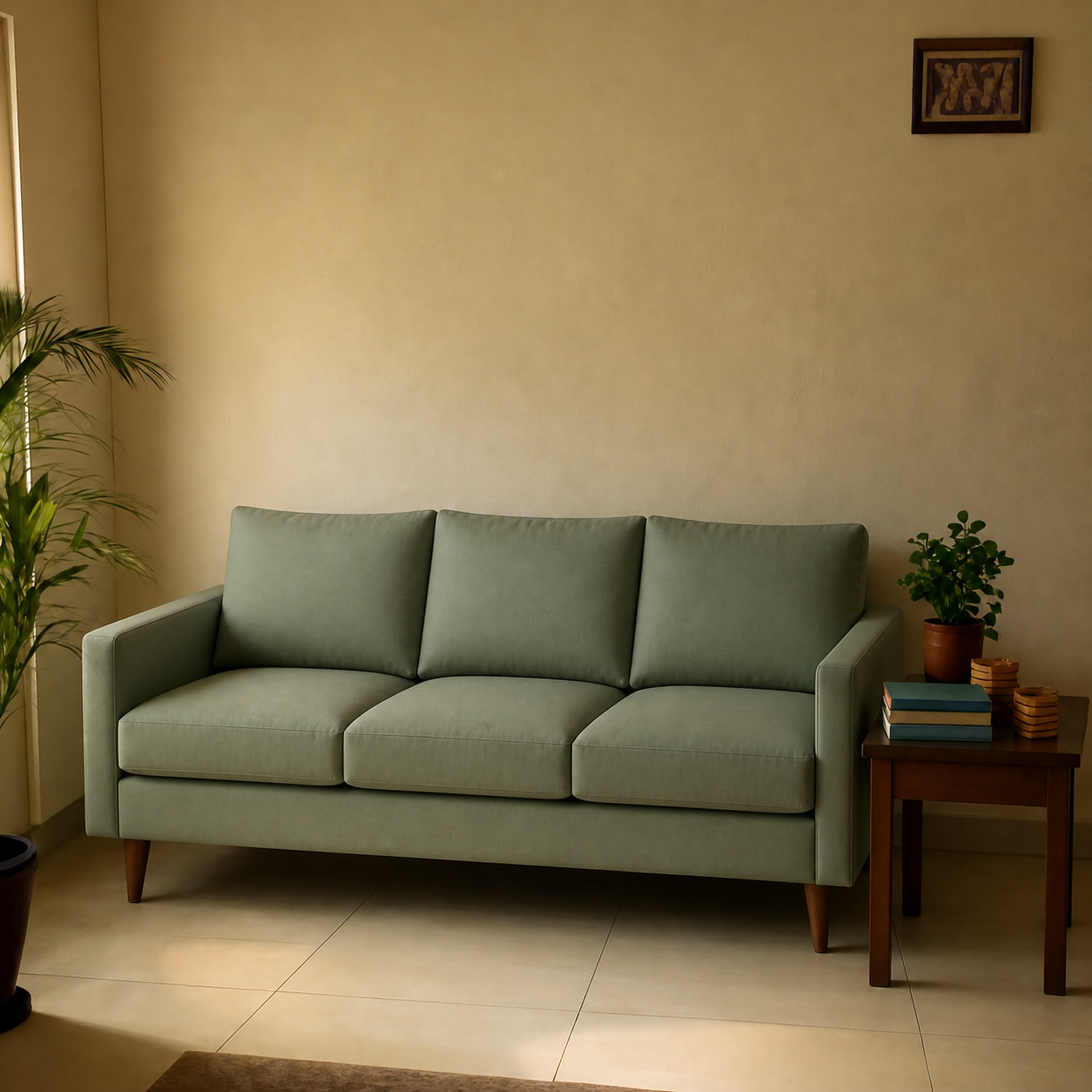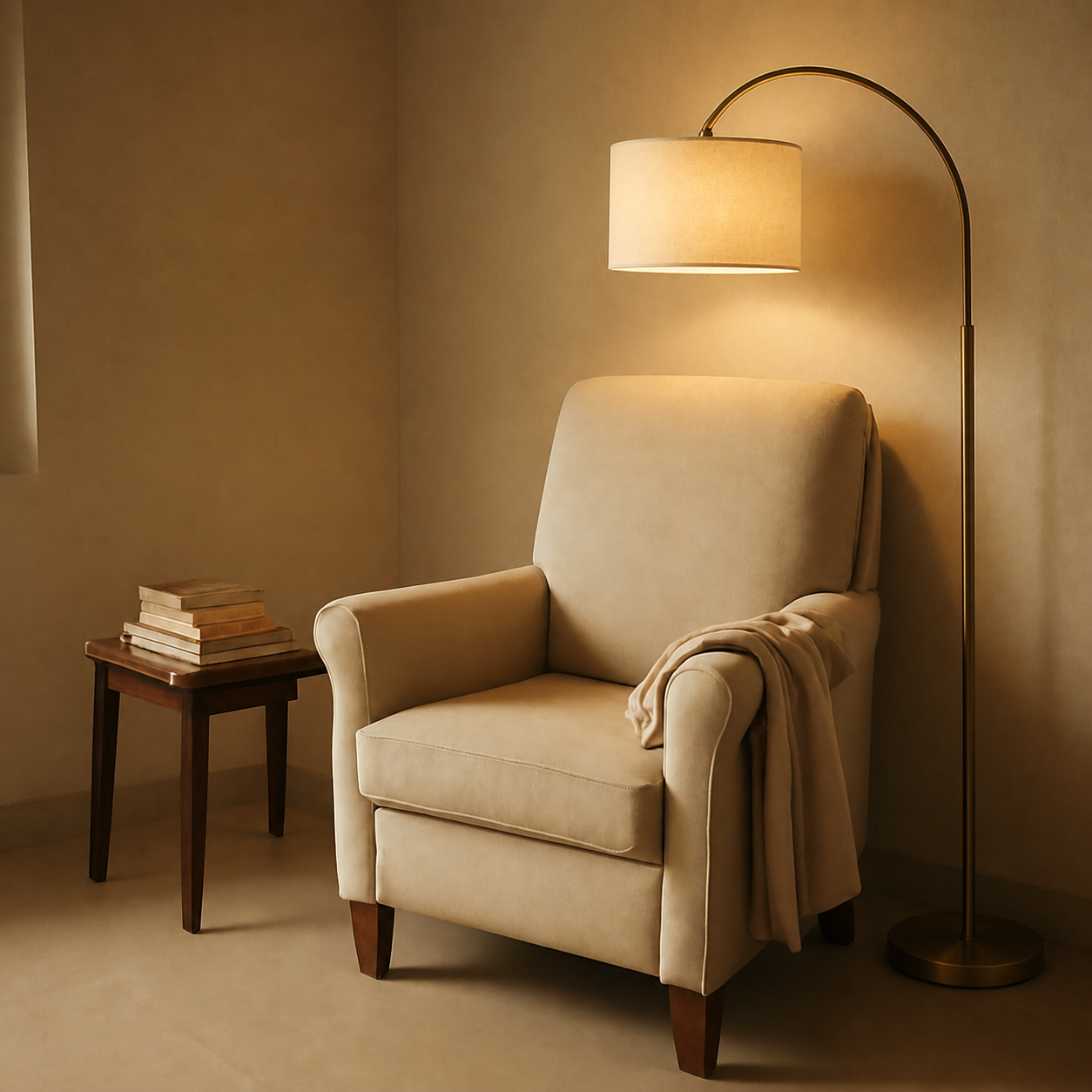
An accent chair fits the scale of a room when its seat height is within 2 inches of the sofa, its overall height stays under the sofa back, and it has at least 30 inches of clear bubble around it. Listings make chairs look bigger or smaller than they are because models and props are styled for impact, not scale. Tape out the chair's footprint, check the four-foot bubble rule, and preview it in a photo of the actual room — those three steps catch the “it looked great online” problem.
Why accent chairs are the easiest piece to scale wrong
A sofa is photographed with a model on it. A coffee table is shot from above with books arranged on top. An accent chair is photographed alone in an empty studio with no reference object — and that is exactly why scale fails for them more than any other piece. There is nothing to compare it to.
The two ways an accent chair fails in a room:
- Too small. Looks like a doll's chair next to a deep-seat sofa. Disappears in the room.
- Too tall. Towers over the sofa, breaks the eye-line, dominates the room. Common with wing chairs and high-back accent chairs.
Scale relative to the sofa — three measurements
Every accent chair should be checked against the sofa, not the room. The sofa sets the room's scale; everything else relates to it.
| Dimension | Target relative to sofa | Acceptable range |
|---|---|---|
| Seat height | Match the sofa | ±2 in / 5 cm |
| Overall height | At or just under sofa back | −4 in to +2 in |
| Seat depth | Match the sofa | ±3 in / 7 cm |
| Arm height | Match or lower | ±2 in |
A sofa with an 18-inch seat height paired with a 22-inch chair seat is the most common mismatch — the person on the chair sits four inches above the person on the sofa and the conversation circle breaks.
Key takeaway
The single most important match is seat height. Get it within 2 inches of the sofa and the chair will read “intentional” even if it's a different style.
Proportion to the coffee table
The accent chair's seat should sit 14-18 inches from the edge of the coffee table. Closer and you can't cross your legs. Farther and you have to lean forward to reach a cup. This determines where the chair physically lives, which in turn dictates how much floor it takes up.
- Chair arm to coffee table edge: 14-18 in / 35-45 cm.
- Coffee table height: within 1-2 in of the sofa seat height.
- Coffee table length: roughly two-thirds the length of the sofa.
The 4-foot bubble rule
Every accent chair needs a 4-foot bubble of clear space — 30 inches in front for legroom, 12 inches on each side for the arms not to crowd a wall or another piece, and 6 inches behind for the chair to push back from the wall slightly so it doesn't scuff paint.
If the chair can't have that bubble, it's not the right chair for the room. This is the rule that gets violated most in small living rooms — the chair fits, technically, but the room feels jammed once it's there.
The tape-and-stand-in workflow
- 1Tape out the chair's footprint on the floor where you're considering placing it. Include the depth, not just the seat dimensions.
- 2Stack two cushions to the chair's seat height — sit on them at the taped spot. Can you reach the coffee table without leaning?
- 3Walk around the taped footprint. Is there a 30-inch clearance in front and 12 inches to either side?
- 4Hold a piece of cardboard or a large book at the chair's back height. Does the silhouette feel right next to the sofa?
- 5Preview the actual chair in a photo of the actual room before ordering.
Where the photo preview earns its keep
The tape test catches scale and clearance. It misses three things, all of which are the most common reasons accent chairs get returned:
- Fabric colour against your wall paint and floor.
- How the chair silhouette reads against the sofa silhouette.
- Whether the chair's shape language matches or fights the rest of the room.
Dropping the product image of the chair into a room visualizer with a photo of your actual living room solves all three in seconds — you see fabric against wall, silhouette against sofa, and shape against the existing pieces, all at correct scale. See a worked example — the same technique that works for sofas works for chairs.
Accent chair sizes by room
| Room size | Sofa size | Accent chair size |
|---|---|---|
| Small (10'×12') | 72 in / 183 cm | 28-30 in wide, 30-32 in deep |
| Standard (12'×15') | 84 in / 213 cm | 30-34 in wide, 32-36 in deep |
| Large (15'+) | 90 in+ / sectional | 34-40 in wide, 36-40 in deep |
Anything under 28 inches wide is a side chair, not an accent chair — it reads small in any seating arrangement. Anything over 40 inches wide is moving into oversized-armchair territory and needs the room to absorb it.
Common accent-chair mistakes
- Buying for the listing photo, not the room. Studio shots with neutral walls and oversized props flatter the chair. Your actual living room will not.
- The lone wing chair next to a low-back sofa. A 44-inch-tall wing chair next to a 32-inch-tall sofa breaks the eye-line and makes the sofa look squatty.
- Two chairs that should have been one. A pair of small accent chairs across from a sofa often reads weaker than one substantial chair with a side table. Symmetry isn't always the answer.
- Ignoring depth. A 38-inch-deep accent chair in a 12-foot-wide living room steals a walkway. Measure depth before length.
- Skipping the preview. For an end-to-end version of the same workflow on larger furniture, see how to tell if a sofa will fit and how to match new furniture to existing decor.
Quick checklist
- 1Seat height within 2 inches of the sofa.
- 2Overall height at or just under the sofa back.
- 34-foot bubble of clear space around the chair.
- 414-18 inches from the chair to the coffee table.
- 5Preview the chair in a photo of the actual room before ordering. Browse the sofa category for matching scale references.