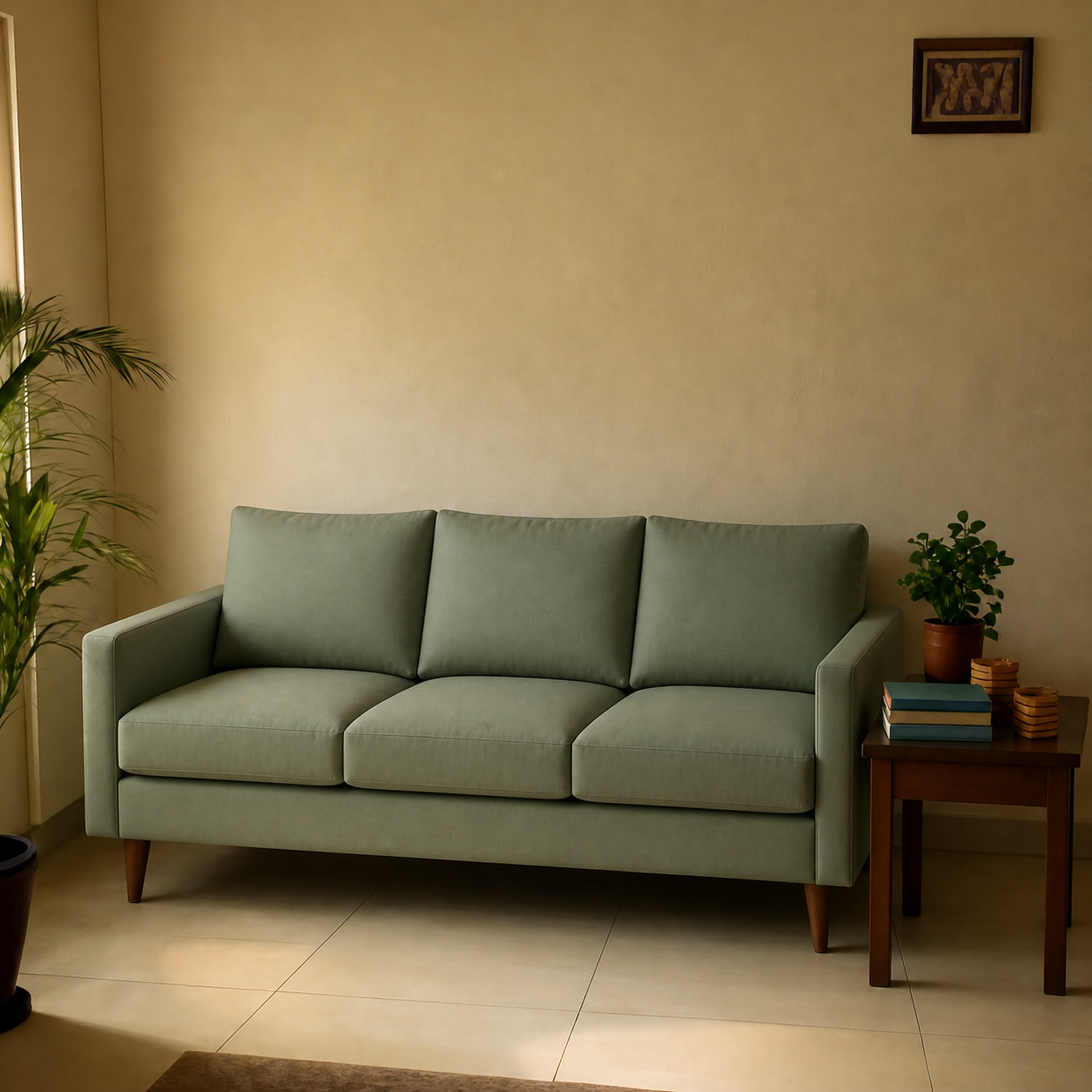
Knowing whether a sofa will fit in your living room before you buy it comes down to three checks: doorway clearance, wall length, and how much floor space the sofa leaves for walking around it. Tape-outline the footprint on your floor and measure the wall — these alone catch most of the “it didn't fit” returns. For colour and visual scale, which the tape measure can't solve, a photo preview of the exact sofa in your actual room is the only reliable check.
The two ways a sofa “doesn't fit”
When people return a sofa and say it didn't fit, they almost always mean one of two things:
- Physical fit:the sofa wouldn't go through the door, around the stairwell, or against the wall it was bought for.
- Visual fit: the sofa physically fit, but it dwarfed the rest of the furniture, drowned the wall, or read the wrong colour against the floor.
Most online furniture return reports group both into one bucket. The second one is more common, and it's the one most measurement guides skip — because you can't solve it with a tape measure alone.
Step 1 — Doorway, stairwell, and elevator check
Boring but unskippable. Sofa deliveries fail most often at landings and stairwell turns, not the front door. Measure these three numbers:
| Where | What to measure | Typical minimum |
|---|---|---|
| Front door | Width with door open at 90° | 32 in / 81 cm |
| Hallway corner | Diagonal across the turn | Sofa depth + 6 in |
| Stairwell | Ceiling-to-step at the turn | Sofa length minus 4 in |
| Elevator | Diagonal floor-to-ceiling | Sofa length |
Most three-seat sofas (84 in / 213 cm) fit through a standard 32-inch doorway tipped on their side. The problem is rarely the door itself — it's the right-angle turn just past the door, or the first stairwell landing. Measure those diagonals, write them down, and compare against the sofa's listed length and depth before ordering.
Key takeaway
The dimension that determines whether a sofa fits is the stairwell or hallway diagonal — not the door width. Sellers almost never mention this.
Step 2 — Measure the wall, not the sofa
This is the step that prevents the “too long” or “too short” mistake. Stand at the wall the sofa will sit against and measure its full length, then apply the two-thirds rule:
The sofa should occupy roughly two-thirds of the wall it sits on. Less than half and the wall feels under-furnished. More than three-quarters and the room feels heavy. It's a starting point, not a hard rule, but it catches the common mistakes.
Examples for the most common sofa sizes:
- 10-ft wall (120 in) → a 78–84 in sofa hits the sweet spot.
- 12-ft wall (144 in) → 90–96 in sofa, or an apartment sectional.
- 14-ft+ wall (168 in+) → full-size sectional territory.
Step 3 — Tape it out on the floor
Once you have a sofa in mind, take painters' tape and outline the exact footprint on your floor — full length, full depth. Then walk around it for ten minutes. Pretend you're carrying a cup of tea. Pretend someone is sitting on it and you need to walk past.
Almost every “fit” problem people don't notice until delivery is about traffic flow, not dimensions. The coffee table that leaves no room to step around. The chaise that blocks the path to the kitchen. The 18 inches of legroom a deep-seat sofa needs that the tape measure won't flag.
Step 4 — The depth problem most people miss
Sofa depth has gotten dramatically larger in the last decade. Deep-seat designs that imitate the lounge-style Restoration Hardware and Crate & Barrel pieces are often 40–46 inches deep, compared to traditional 32–36 inches.
A deep-seat sofa needs more than its footprint:
- People sit further forward, so legroom needs another 6 inches in front of where the cushions end.
- A coffee table that worked with a 34-inch-deep sofa will feel too far from a 44-inch one.
- Visually, deep sofas anchor the room — they make narrow rooms feel narrower.
If your room is under 12 feet wide, default to a 36-inch-deep traditional sofa unless you're sure about the look.
Step 5 — Preview the sofa in a photo of your room
Steps 1–4 catch the measurement mistakes. Step 5 catches everything else: colour against your wall paint, scale against your other furniture, how the sofa back reads against your window or your art. These are the parts of “fit” that no measurement guide can solve, because they depend on your specific room.
The fastest way to check this is to drop the product image — or an Amazon link to the exact sofa — into a room visualizer that places it into a photo of your actual living room. PlopIt previews any sofa in your room at correct scale, lighting, and perspective. It's free, no signup, and works with any sofa from any retailer where you can grab the product image.
Common mistakes — the receipts
- Chaise on the wrong side. Left-arm-facing vs right-arm-facing is decided by standing in the room and looking at the sofa, not by looking at the product photo. Reversing this is one of the most common online sectional mistakes — and the return shipping is on you.
- Measuring an empty room. The empty room always feels bigger than the lived-in one. Measure with your existing rug, coffee table, and side tables in place.
- Trusting the model-shot scale. Stylists photograph sofas with five-foot-tall models and oversized throw pillows to make pieces look proportional. The 84-inch sofa in the listing is the same 84 inches in your living room as everywhere else.
- Ignoring depth. Sofa length gets all the attention; sofa depth quietly decides whether your room still has a walkway.
- Skipping the visual check. A sofa that fits on paper can still feel wrong in the room. A ten-second photo preview catches this; a tape measure won't.
Quick checklist
- 1Measure the diagonal of every hallway turn and stairwell on the delivery path.
- 2Measure the wall the sofa will sit against. Aim for two-thirds wall coverage.
- 3Tape out the footprint on your floor and walk around it for ten minutes.
- 4Check the depth — and plan another 6 inches of legroom for deep-seat designs.
- 5Preview the exact sofa in a photo of your room before ordering.