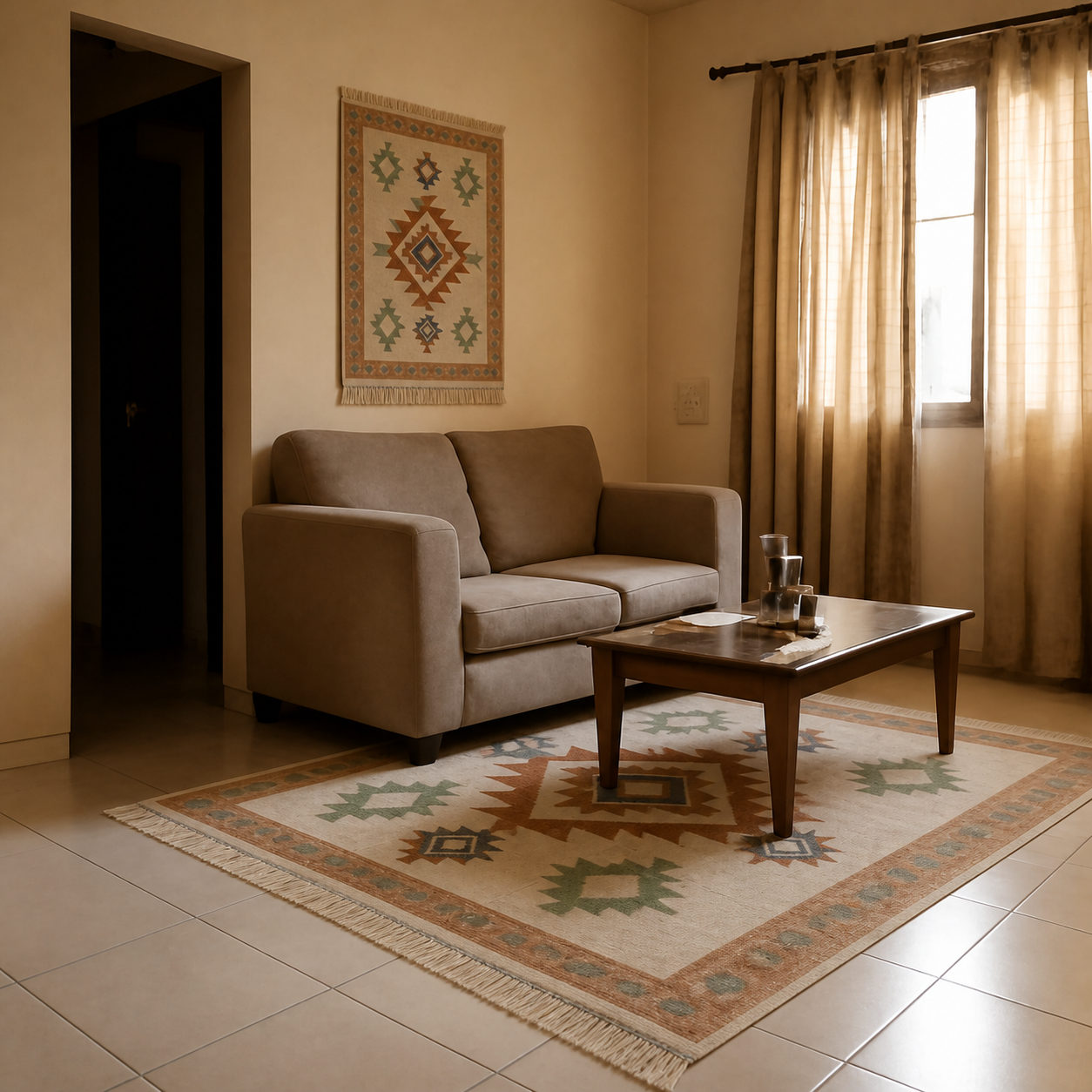
Choosing a rug for a living room is four decisions: size, material, style, and colour. Size is the one most people get wrong (covered in depth in the rug-size guide); material decides how the rug feels underfoot and how long it lasts; style and colour decide whether the rug anchors the room or fights it. Below is a practical guide to the last three — the questions you ask after you've already nailed the size.
If you haven't picked a size yet, start with the rug-size guide — get that right first and the rest is much easier.
Step 1 — Pick the material
Material drives everything else: how the rug feels, how long it lasts, how it cleans, and how much it costs. The major options:
| Material | Feel | Durability | Best for |
|---|---|---|---|
| Wool | Soft, warm | Excellent (decades) | Living rooms with regular use |
| Cotton flatweave | Smooth, casual | Good (years) | Casual rooms, kids, summer climates |
| Jute / sisal | Coarse, natural | Very good | Layering under wool, neutral base |
| Synthetic (polypropylene) | Varies — often stiff | Good for pets / stains | High-traffic, pet households |
| Silk / silk blend | Luxuriously soft | Delicate | Low-traffic, statement rooms |
For most living rooms, hand-tufted or hand-knotted wool is the right default. It pays back its higher price in lifetime — a good wool rug genuinely lasts decades. Synthetic only beats wool on price and on stain resistance for households with very young kids or pets.
Step 2 — Match the style to your room
Style is where most rug regret happens. The rug that looks magnificent on a white-walled studio shot can fight a richly furnished living room — and vice versa. The rough mapping:
- Quiet room (neutral walls, simple furniture): a more patterned or richly coloured rug becomes the focal point. Vintage Persian, ornate kilim, or a saturated wool tufted design.
- Busy room (statement art, patterned upholstery): a quieter rug holds the space together. Solid wool, low-contrast geometric, or a textured jute.
- Open-plan space: the rug also defines zones. A more visible pattern helps anchor the seating area inside a larger floor.
The rule: one focal layer per room. If the walls or furniture are loud, the rug should be quiet. If the walls and furniture are quiet, the rug can be the loud one.
Step 3 — Choose colour against your room, not against the listing
Rug colours photograph misleadingly. Vintage Persians look richer under studio lighting; flat-woven cottons look more saturated. Three colour checks:
- The rug's dominant colour should appear in at least one other thing in the room — a cushion, a piece of art, a vase. This is what makes the space feel intentional rather than mismatched.
- Wood floor tone affects perception. Warm wood (oak, teak) makes warm rugs read warmer; cool wood (walnut, dark-stained) cools the rug. A rug that looks neutral in a showroom can read very different at home.
- Bright daylight saturates colours; lamp light flattens them. Look at the rug in both before deciding.
Step 4 — Preview before buying
Rugs are the most-returned home category, and the dominant reasons are size mismatch and the rug reading differently in person than the listing suggested. Both are catchable upstream.
Tape out the size on your floor, then preview the actual rug pattern and colour in a photo of your room. The combination catches both the size and the visual mismatch before delivery. See the example or browse the rug visualizer.
Quick decision checklist
- 1Size: 8'×10' or 9'×12' for most living rooms; front legs of every seat must sit on the rug.
- 2Material: wool by default; synthetic if pets or kids dominate; jute for layering.
- 3Style: one focal layer per room. If walls and furniture are quiet, rug loud. Else, rug quiet.
- 4Colour: dominant colour must echo something else in the room. Check under daylight and lamp light.
- 5Preview the actual rug in a photo of your room before clicking buy.