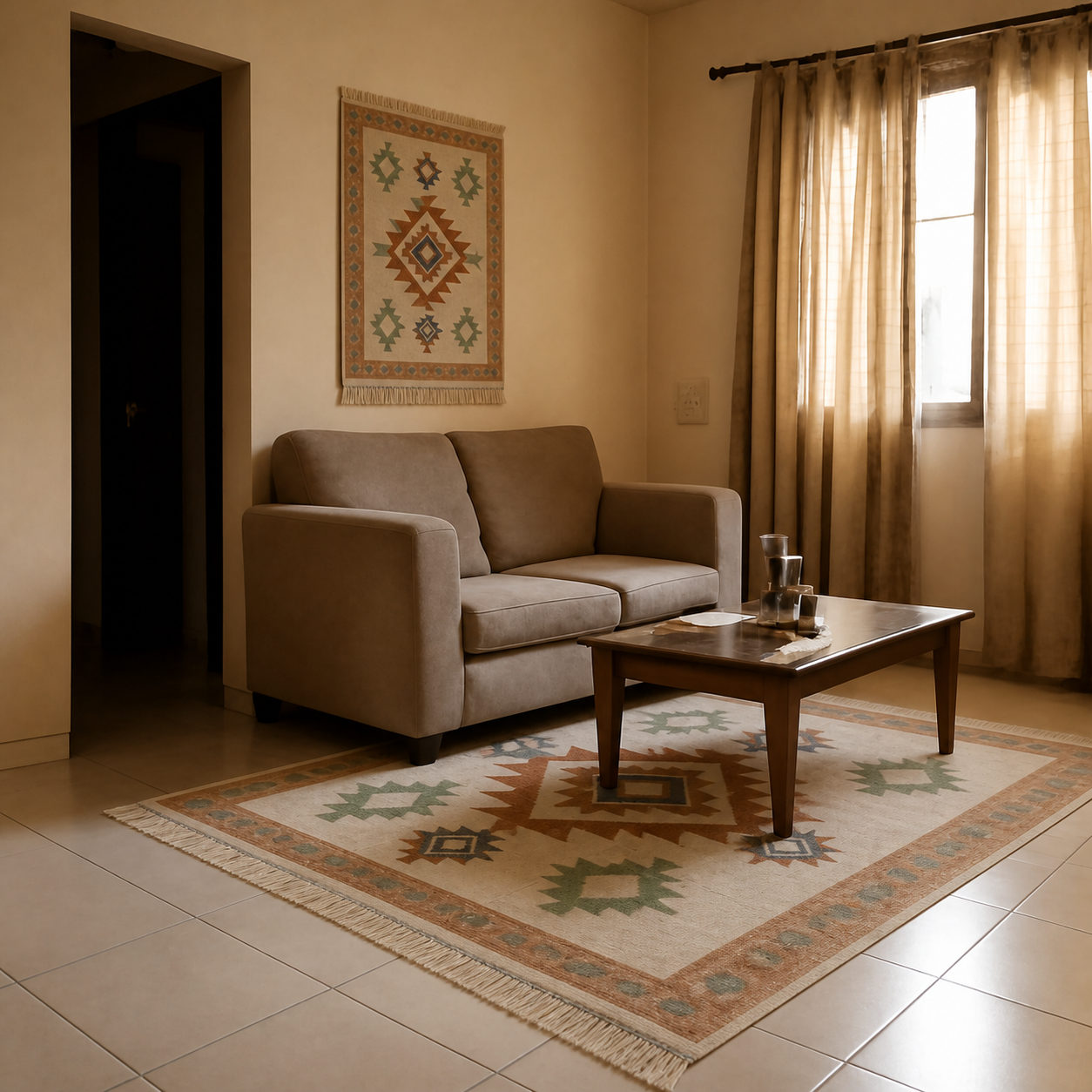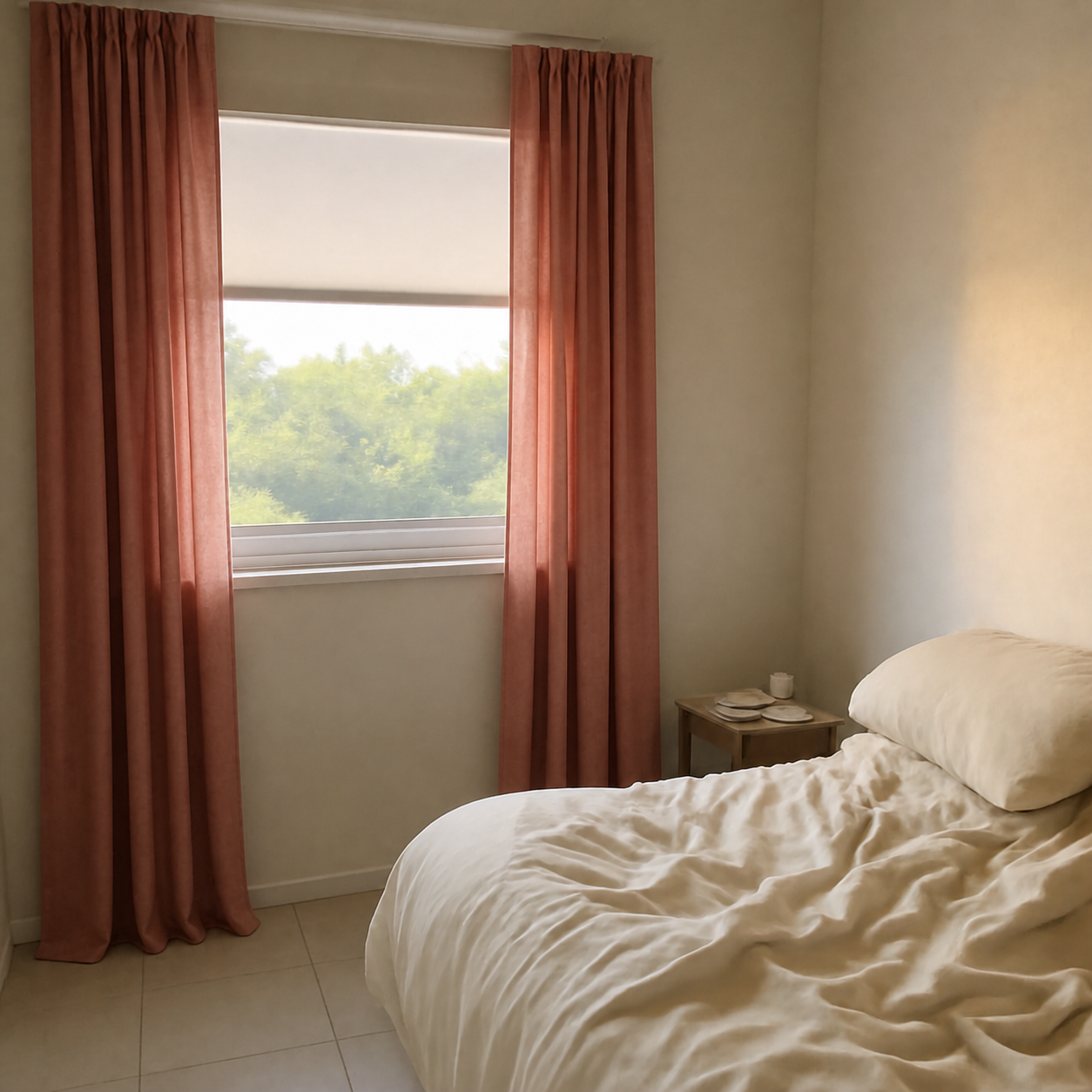
Bedroom rugs are sized relative to the bed, not the room. The rug should extend at least 24 inches (60 cm) past each side of the bed and 36 inches past the foot, so your feet land on it the second you step out. For a queen bed that means an 8'×10'; for a king, a 9'×12'. The most common mistake is buying a 5'×7' and stuffing it under the bottom third of the bed — it almost always reads small and saves nothing visually.
Why bedroom rugs follow the bed, not the room
Living-room rugs anchor seating; bedroom rugs anchor the bed. The bed is the largest single object in the room and the only thing whose scale most other furniture defers to. If the rug doesn't relate to the bed clearly, the whole room reads off.
There are three workable layouts. Each one starts from a different question about where you want softness underfoot:
- Under-bed extension. One large rug runs under the bottom two-thirds of the bed and extends past the sides and foot. The most common layout, and the one most beds in catalogue photos use.
- Foot-of-bed only. A wider rug sits across the foot of the bed, not under it. Used when the bedside floor is a beautiful wood you don't want to cover, or when the rug is small.
- Two runners. A 2.5'×8' runner on either side of the bed instead of one big rug. Cheapest option and the only one that works in tight bedrooms with bedside tables to either side.
Rug size by bed size — the cheat sheet
Match the rug to the mattress, not the bedroom. These are the sizes that leave the right amount of rug visible past the bed for the under-bed-extension layout.
| Bed size | Mattress dimensions | Ideal rug | Minimum rug |
|---|---|---|---|
| Twin / Single | 38 × 75 in | 5'×8' | 4'×6' |
| Full / Double | 54 × 75 in | 6'×9' | 5'×8' |
| Queen | 60 × 80 in | 8'×10' | 6'×9' |
| King | 76 × 80 in | 9'×12' | 8'×10' |
| California King | 72 × 84 in | 9'×12' | 8'×10' |
Key takeaway
For under-bed-extension layouts, the rug should be at least the bed width + 48 inches and the bed length + 36 inches. Anything smaller and your feet land on cold floor when you get out of bed.
The under-bed extension rule
The right amount of rug visible past the bed is the one detail that separates a designed bedroom from a rug-on-a-floor. The convention is:
- 24 inches (60 cm) of rug visible on each side of the bed.
- 36 inches (90 cm) of rug visible past the foot.
- The rug usually starts about a third of the way down the bed — bedside tables sit on the bare floor, not on the rug.
Pulling the rug all the way to the headboard wall is the other common mistake. Bedside tables on rug edges wobble, and a rug crammed under the headboard reads cluttered. Leave the top third of the bed off the rug.
When two runners beat one big rug
Runners on either side of the bed are the right call in three scenarios:
- 1The floor under the bed is a great rug already, or a wood you want to keep visible.
- 2The bed has storage drawers underneath — a big rug under the bed pins them shut.
- 3Budget. Two 2.5'×8' runners cost a fraction of a 9'×12' rug and cover the only floor your feet actually touch.
Runners should match each other exactly and run parallel to the bed, starting around the level of the pillows and extending to about a foot past the foot of the bed.
Small-bedroom adjustments
Indian master bedrooms and US apartment bedrooms tend to be 10'×11' or 11'×12' — barely enough room for a queen bed plus side tables. The big rug under the bed often won't fit without crashing into the wardrobe or the door swing.
In that case, drop one size below the “ideal” in the table above — a 6'×9' under a queen still works if you push it past the foot of the bed and accept slightly narrower side margins. Or switch to runners.
Common bedroom-rug mistakes
- The placemat rug. A 5'×7' under a queen bed shows about 12 inches on either side — reads like the rug shrunk in the wash. Either go bigger or skip the big rug and use runners.
- Bedside tables on rug edges. Tables sitting half-on, half-off the rug wobble and look unintentional. Either fully on (rare) or fully off.
- Matching the rug to the wall colour. A rug that disappears into the wall makes the floor look smaller. The rug should contrast the floor and relate to the bedding, not camouflage with the paint.
- Skipping the visual check. Pattern density and the way a rug reads under specific bedside lighting are the things tape measures don't catch. Preview the exact rug in a photo of your bedroom before ordering.
How to confirm before you buy
Tape out the rug's dimensions on the bedroom floor with painters' tape. Move around the bed. Open the wardrobe doors, swing the bedroom door, sit on the edge of the bed. This catches the “the rug stops the wardrobe opening” problem in five minutes and costs nothing.
Then drop the actual product image of the rug into a rug visualizer and place it into a photo of your bedroom. Pattern, pile and how the rug reads against your bedding aren't guesses — they're visible in seconds. The same logic that living-room rug sizing relies on applies here, but the reference object changes from the sofa to the bed.
Quick checklist
- 1Match the rug size to the bed size, not the room. Queen = 8'×10', King = 9'×12'.
- 2Aim for 24 inches of rug visible on each side and 36 inches past the foot.
- 3Start the rug about a third of the way down the bed — bedside tables on bare floor.
- 4If the big rug won't fit, switch to two 2.5'×8' runners flanking the bed.
- 5Tape it out, then preview the exact rug in a photo of the room before ordering.