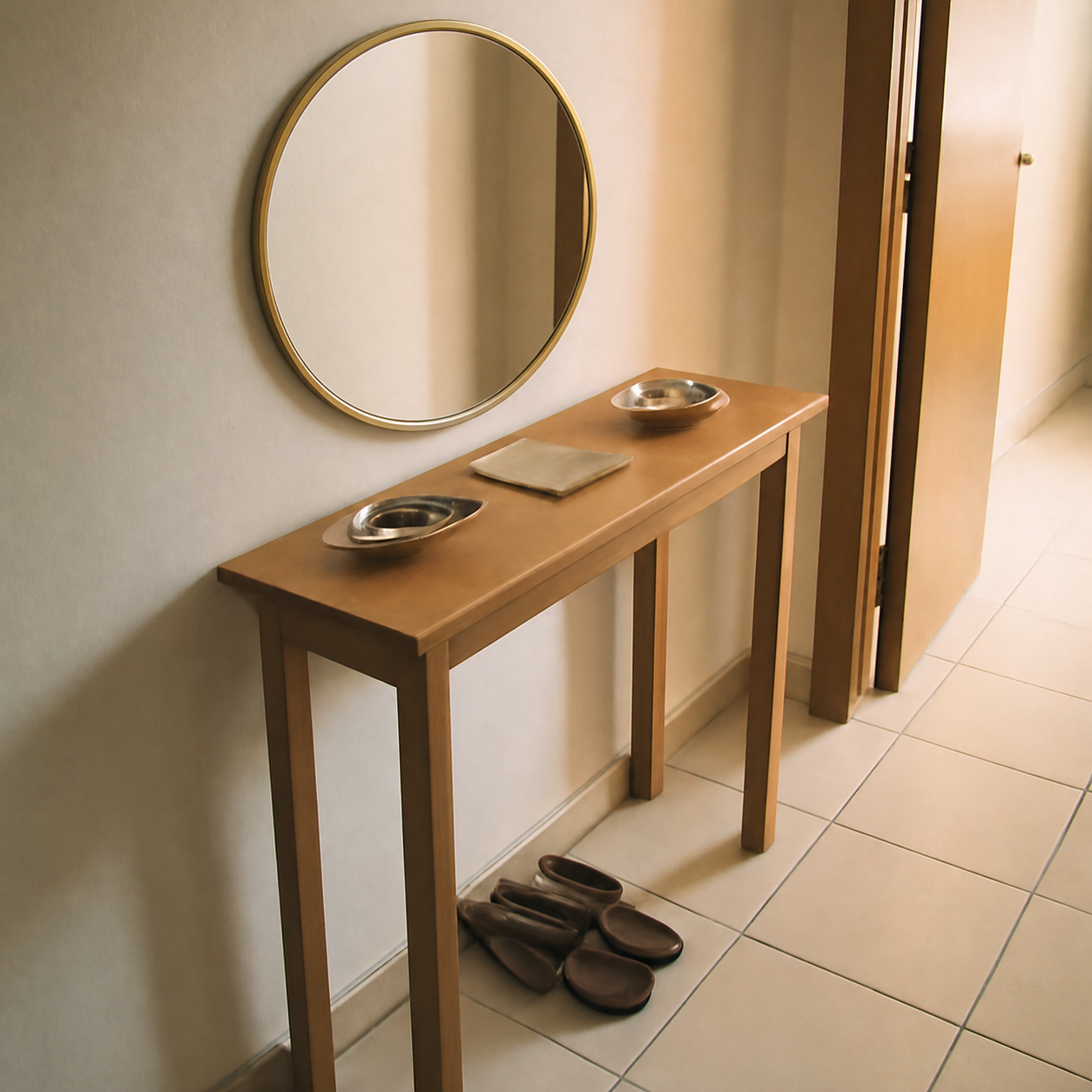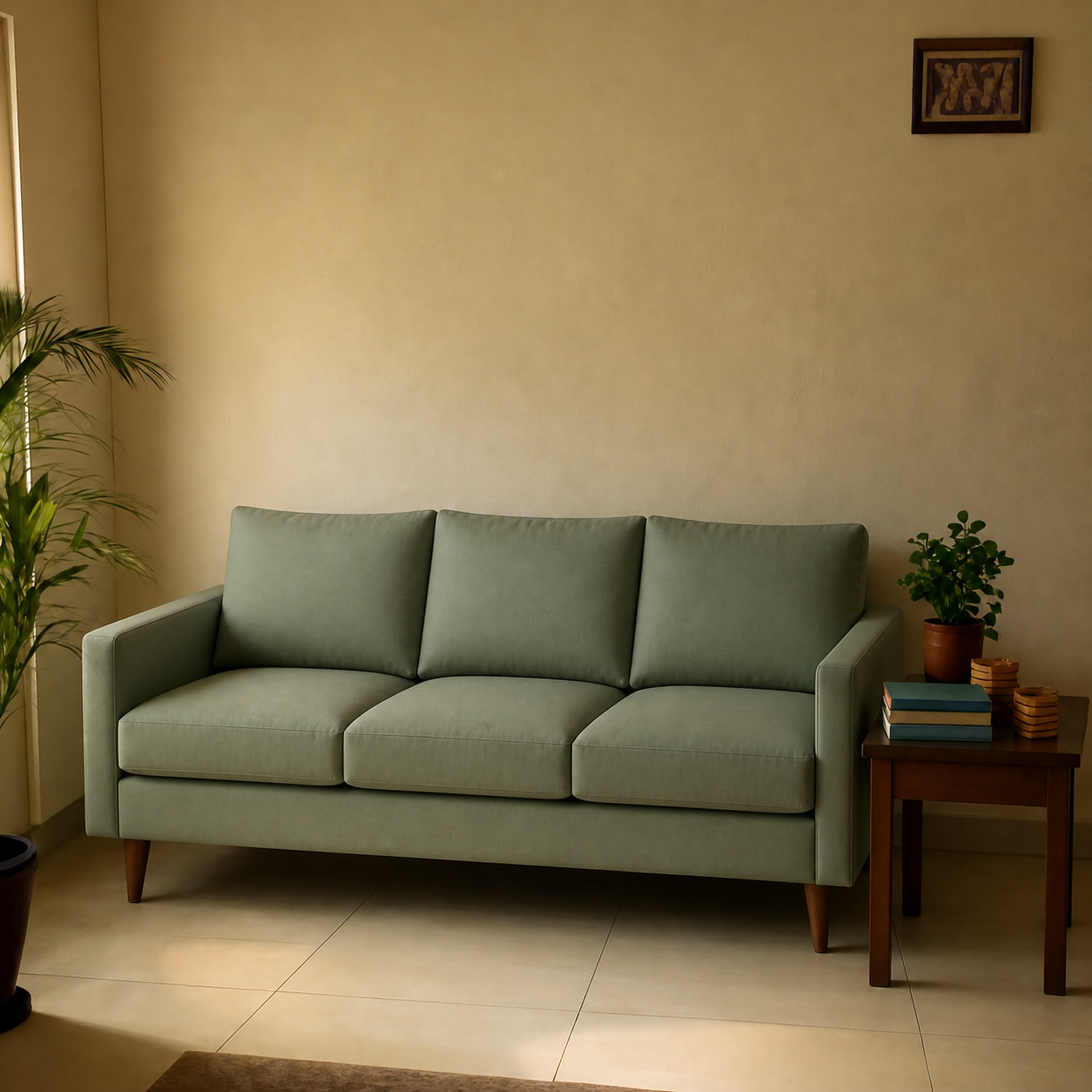
Mirrors and wall art are harder to preview than furniture because you can't tape them out — they sit flush on a vertical surface you walk past, not floor space you stand inside. The reliable workflow is to size by the furniture below (target two-thirds of the console or sofa width), centre the piece at 57-60 inches eye-level, and preview it in a photo of the actual wall. Newspaper-taped outlines work for size; only a photo preview catches frame colour, scale relative to the room, and whether the piece reads the way you imagined.
Why mirrors and art are uniquely hard to preview
Furniture sits on the floor. You can tape its footprint, walk around it, sit in the empty space and imagine it. Mirrors and wall art defeat all three of those tests:
- You can't tape a vertical area on a wall and read it the same way.
- The listing photo shows the art at the camera's height, not yours — a 36'' piece looks “medium” in a stylist's frame and tiny on a 12-foot wall.
- The frame colour shifts dramatically with the wall paint and surrounding wood tones.
This is why “I thought the mirror would be bigger” is one of the most common return reasons in homeware categories.
Sizing rule — two-thirds of the furniture below
The reference for sizing a mirror or art is almost always the furniture it hangs above — not the wall.
- Above a sofa or console: the piece should span two-thirds to three-quarters of the furniture's width.
- Above a bed: the piece should span the width of the headboard, give or take 4 inches on each side.
- Above a fireplace: the piece should span the width of the mantel, no wider than the firebox plus 6 inches.
- Solo on a wall: the piece should occupy 50-75% of the wall's usable width.
The most common failure is going too small — a 24-inch mirror floating above an 84-inch sofa reads like a postage stamp. If in doubt, size up.
Standard sizes by wall and furniture
| Location | Furniture width | Ideal piece width |
|---|---|---|
| Above 3-seat sofa | 84 in / 213 cm | 56-63 in / 142-160 cm |
| Above loveseat | 60 in / 152 cm | 40-45 in / 102-114 cm |
| Above console | 48-60 in / 122-152 cm | 32-45 in / 81-114 cm |
| Above queen bed | 60 in / 152 cm | 45-55 in / 114-140 cm |
| Entryway mirror | — (solo) | 24-32 in / 60-81 cm wide |
| Full-length mirror | — (solo) | 20-30 in × 60-72 in |
Hanging height — the 57-60 inch rule
Galleries and museums hang art so the centre of the piece sits at 57-60 inches off the floor — average human eye level. This is the single most-violated rule in homes. People hang art four to eight inches too high because they think it should “feel up there”.
The exceptions:
- Above furniture: the bottom of the piece sits 6-12 inches above the furniture top, not at 57-60 in absolute. The piece relates to the furniture, not the floor.
- Tall ceilings (10 ft+): centre can move to 62-66 in, but never higher.
- Entryway mirror: top at 6 ft so even tall guests can see themselves.
Key takeaway
Hang the centre at 57-60 in, or — when over furniture — leave 6-12 in between the top of the furniture and the bottom of the piece. Do not hang to fill empty wall.
Wall margins — the 4-6 inch buffer
Leave at least 4-6 inches of empty wall on either side of the piece — and ideally 8-12 inches if the wall is wider than 8 feet. Pieces shoved against a corner or a window frame look like the wall ran out of room.
Margins matter for a gallery wall too: 2-3 inches between frames is the tight default; 4-5 inches reads more curated.
The newspaper-and-tape preview (does half the job)
- 1Tape newspaper sheets together to the listed dimensions of the piece.
- 2Use painters' tape to stick the rectangle on the wall where the piece would go, centred at 57-60 inches.
- 3Step back to where you normally sit. Read the proportion against the furniture and the wall.
- 4Live with it for 24 hours. If it disappears, size up.
Newspaper catches size and placement. It tells you nothing about whether the actual piece — its colour, its frame, its texture — will read right against your wall. That's where a photo preview takes over.
How to preview the piece against your wall in a photo
Drop the product image into a tool that places it into a photo of your actual wall at correct scale. The same workflow that places a sofa into a living room places a mirror or framed print against a wall — what changes is the reference object.
See a mirror placed into an entryway or browse the mirrors category to see how the workflow handles reflections and frame finishes. For framed art, the same approach works — colour against wall paint is the single biggest variable the listing photo hides.
Mirror-specific considerations
Mirrors do something framed art doesn't: they reflect whatever is across the room. Before buying, ask:
- What sits directly across from this wall? A mirror reflecting a wardrobe full of clothes is different from a mirror reflecting a window.
- Will the mirror bounce light into the room (good) or only reflect ceiling (wasted)?
- Frame finish vs the dominant metal in the room — does it echo or fight?
For coordination across new pieces and the room you already have, see how to match new furniture to existing decor.
Common mistakes
- Hanging it too high. Hanging at 65-70 in disconnects the piece from the furniture below. The centre belongs at 57-60 in.
- Sizing down. A small piece on a large wall reads as a hesitation. The wall looks under-decorated, not minimalist.
- Frame colour camouflage. A black frame on a black wall, or a white frame on a white wall, erases the piece. The frame should contrast the wall.
- Ignoring what the mirror reflects. The contents of the opposite wall become part of the mirror.
- Skipping the photo preview. Even with sizing right, colour and texture against your specific wall are unguessable. See the broader photo-preview workflow for context.
Quick checklist
- 1Piece width: two-thirds to three-quarters of the furniture below.
- 2Hang the centre at 57-60 in, or 6-12 in above furniture.
- 3Leave 4-6 in of wall margin on either side.
- 4Newspaper-tape the outline to test size and placement.
- 5Preview the actual piece in a photo of the actual wall before ordering.