Testing a paint colour, a sofa, and a rug together before buying any of them is the single best way to avoid the Frankenstein-room problem: three pieces that each looked great on their own and clash the moment they share a wall. The right workflow is to digitally preview all three combinations in your actual room first, narrow to two or three combinations that work, and then commit — rather than buying in sequence over weeks and patching mismatches with throw pillows.
Why sequential shopping creates the Frankenstein room
Most living-room refreshes happen in this order: paint the wall on a Saturday because the painters are available, order the sofa six weeks later when the savings show up, find a rug on a festival sale two months after that. Each decision is sensible in isolation. The problem is that the wall colour was chosen for the old sofa, the new sofa was chosen for a paint colour you'd already adjusted to, and the rug was chosen for a photo you remember of the room — not the room as it actually is.
By month four, the wall looks slightly off against the new sofa, the rug pulls a different undertone out of the wall, and you've started buying throw pillows to mediate. The room is functional, but it never quite settles. This is the Frankenstein room — assembled in parts, never designed as a whole.
The three-piece interaction that breaks rooms
Paint, sofa, and rug interact in ways that are hard to predict from individual photos:
- Undertone shifts. A “warm white” wall reads peach next to a cool grey sofa, and ivory next to a beige one. The wall didn't change — the comparison did.
- Pattern weight. A patterned rug and a patterned sofa fight unless one is dramatically dominant. Both at equal weight makes the room read busy.
- Light absorption. A dark wall + dark sofa + dark rug needs significantly more lumens than a light combination. A room that felt fine empty can feel cave-like once the dark trio is in place.
- Scale layering. A small rug under a deep sofa makes the sofa look beached. The same sofa on a larger rug feels grounded. The rug-sofa scale ratio is hard to judge without seeing both in the room.
The right workflow — three combinations, one preview
Instead of buying in sequence, build three full combinations on paper first, preview each in your actual room, then commit to one. Here's the sequence:
- 1Take one good room photo. Daylight, from the doorway, full wall visible. This is the canvas for every preview.
- 2Shortlist two paint colours. The current colour plus one alternative, or two alternatives if you're definitely painting.
- 3Shortlist two or three sofas. Different shapes or colours, not three variations of the same model.
- 4Shortlist two or three rugs. Pattern vs solid, neutral vs accent — give yourself genuine alternatives.
- 5Preview each combination in your room photo. Paint first (digital paint preview), then drop the sofa onto the painted version, then the rug onto that. Three layers, one photo.
- 6Narrow to two combinations. Side by side. Sit with them overnight. Most people's gut reaction holds.
- 7Commit and order in one window. Paint and rug can ship in the same week. Sofa schedules around them.
Tools that let you preview all three together
Most consumer tools handle one of these three categories at a time. The workflow above requires composing them in sequence.
| Layer | What to use | Why |
|---|---|---|
| Paint colour | A digital paint preview, then export the painted photo | Establishes the wall colour as the new baseline |
| Sofa | A photo-composition visualizer that places the real sofa image | Matches the sofa to the new wall, not the old |
| Rug | Same photo-composition tool, layered on top | Lets you judge rug-sofa-wall together in one image |
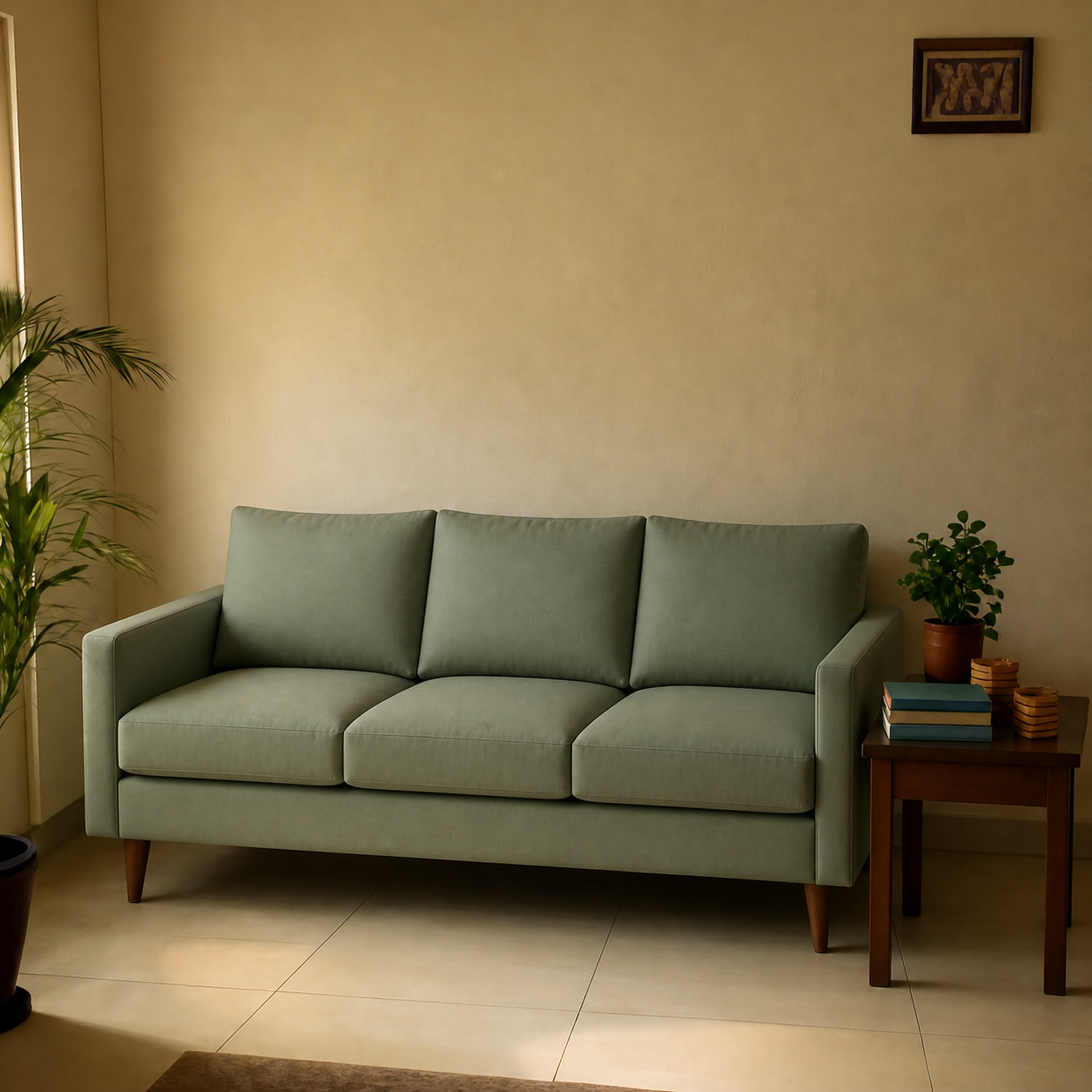
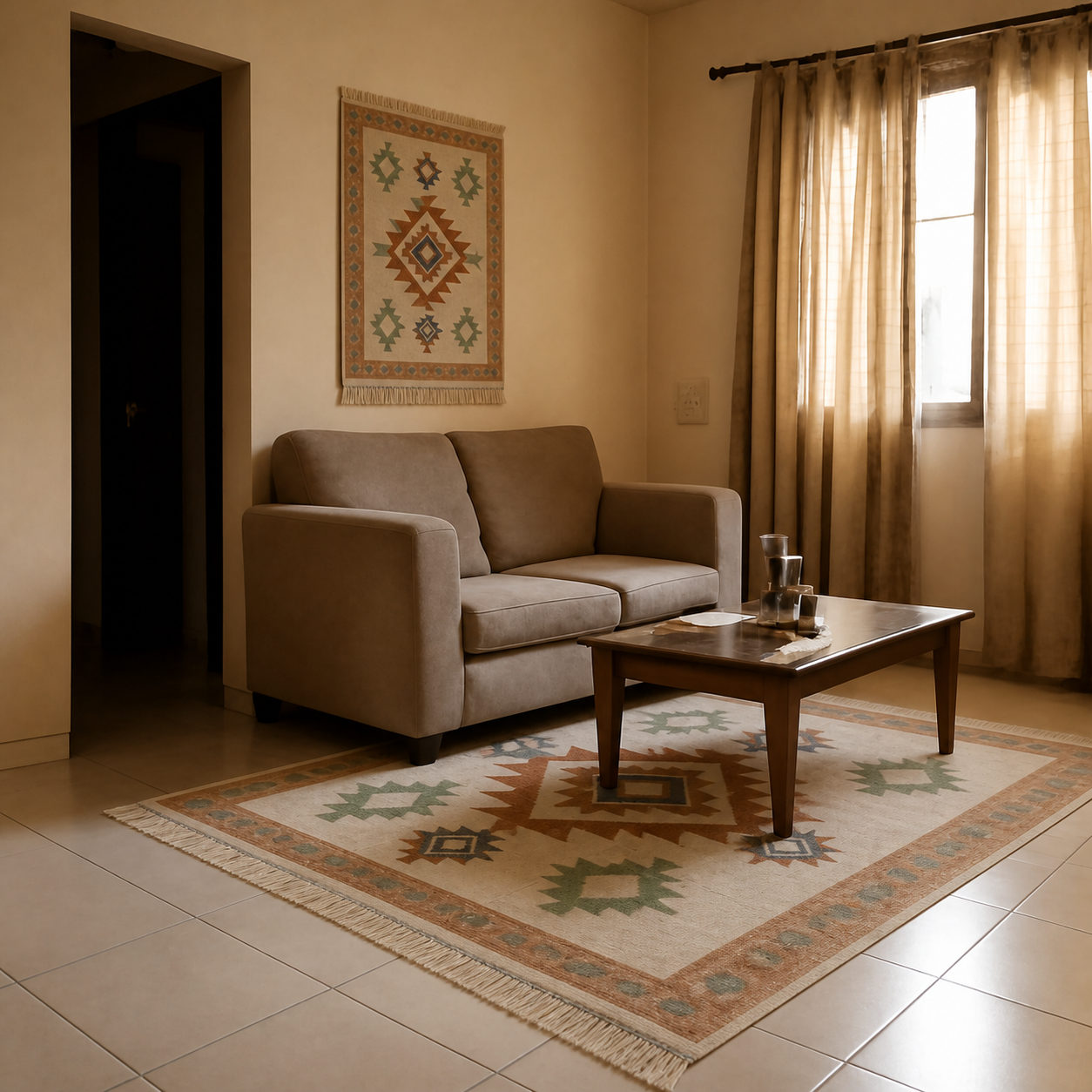
For the paint layer, see the paint preview guide. For the sofa and rug layers, PlopIt accepts your painted-room photo as the input and composes the next piece into it — you can preview the full three-piece combination as a single image.
What to check at each combination
Three honest tests for every combination you preview:
- The squint test. Squint at the preview until everything blurs. The combination should still read as one room, not three separate elements. If one item screams at you when blurred, it's either too dominant or the wrong colour.
- The overnight test. Save the preview, sleep on it, look again in the morning. Combinations you're still excited about the next day are usually the right ones. Combinations that feel just “OK” twice in a row are not it.
- The friend test. Send the previews to one person who has different taste than you. If they immediately call out the same piece you're half-doubting, listen.
Common mistakes when previewing three pieces
- Previewing each piece against a clean white background instead of your actual room. Defeats the entire point. Always start from your room photo.
- Previewing the sofa first, then deciding paint to match. Paint is the cheaper change. Lock the sofa colour you actually want; choose paint to support it.
- Skipping the rug. A rug changes how a sofa reads — undersized makes the sofa look beached, patterned changes the focal point.
- Six combinations instead of three. Decision fatigue. After three or four serious combinations the brain stops differentiating. Narrow ruthlessly.
When to break the rule and buy sequentially
Sequential is fine when:
- You already love the existing wall colour and aren't repainting. Then sofa + rug is a two-piece problem.
- You're replacing one item at a time and the existing two pieces stay. The new piece needs to fit them, which is a single-decision check.
- You have a strong design eye and a fixed palette in your head already. Then sequential just executes the plan you've already made.
The Frankenstein-room problem happens specifically when all three pieces change and the decisions are spread across weeks. That's where the bundled-preview workflow earns its keep.
The single-photo workflow in detail
Step by step, for the case where you're changing paint, sofa, and rug:
- 1Photograph the room in daylight, from the doorway, with the wall the sofa will sit against fully visible. Tile or floor in frame.
- 2Use a digital paint preview to apply your shortlisted colour to the wall. Export the painted photo.
- 3Upload the painted photo to a photo-composition visualizer. Drop in your shortlisted sofa as the next layer. Export.
- 4Upload that painted-plus-sofa photo. Drop in your shortlisted rug. Export the final image.
- 5Repeat the layering for the other one or two combinations. You should end up with two or three final images.
- 6Compare side by side. Apply the squint, overnight, and friend tests.
- 7Order the winning combination. Paint first (lead time), rug second (delivery), sofa last (longest lead time but the room is ready to receive it).
See the sofa living room demo and the rug living room demo for the kind of composition each layer produces. For the underlying choices, the rug-for-living-room guide and the sofa-fit guide cover the per-piece decisions. The matching-furniture-to-existing-decor post is the companion for partial refreshes.
Quick three-piece checklist
- 1Take one good daylight photo of the room. Use it as the canvas for every preview.
- 2Shortlist two paint colours, two or three sofas, two or three rugs.
- 3Layer the preview: paint first, sofa on the painted photo, rug on top.
- 4Build two or three full combinations. Apply the squint, overnight, and friend tests.
- 5Order the winning combination in one window. Don't spread the decision across weeks.