A ₹10,000 budget on Amazon India can transform a 2BHK living room if you spend it on six categories that punch well above their cost: a 5x7 ft rug, a statement mirror, a lamp upgrade, a planter trio, a small art gallery wall, and one compact storage piece. The trick is treating the budget as a single design pass rather than six separate impulse buys — and using a photo preview to catch the scale and colour mistakes before the parcels land at your door.
How to split ₹10,000 across six categories
A practical allocation that covers a typical 2BHK living room plus an entry zone without any single piece feeling lonely or any wall feeling empty:
| Category | What works at this price | Budget |
|---|---|---|
| Living room rug (5x7 ft) | Hand-loomed dhurrie or jute, neutral palette | ₹2,500–₹3,500 |
| Statement mirror | 36-inch round or arched, metal or wood frame | ₹1,800–₹2,800 |
| Floor or table lamp | Tripod floor lamp or fabric-shade table lamp | ₹1,200–₹1,800 |
| Planter trio | Three unglazed terracotta planters, mixed heights | ₹900–₹1,400 |
| Gallery wall (3–5 prints) | A4 prints with simple black or brass frames | ₹800–₹1,400 |
| Compact storage | Slim console, ladder shelf, or two storage baskets | ₹1,200–₹1,800 |
Total at the lower end: ₹8,400. Total at the upper end: ₹12,700. The sweet spot is picking five of these six categories at mid range and skipping the one you already have a passable version of.
Why the rug is the highest-leverage spend
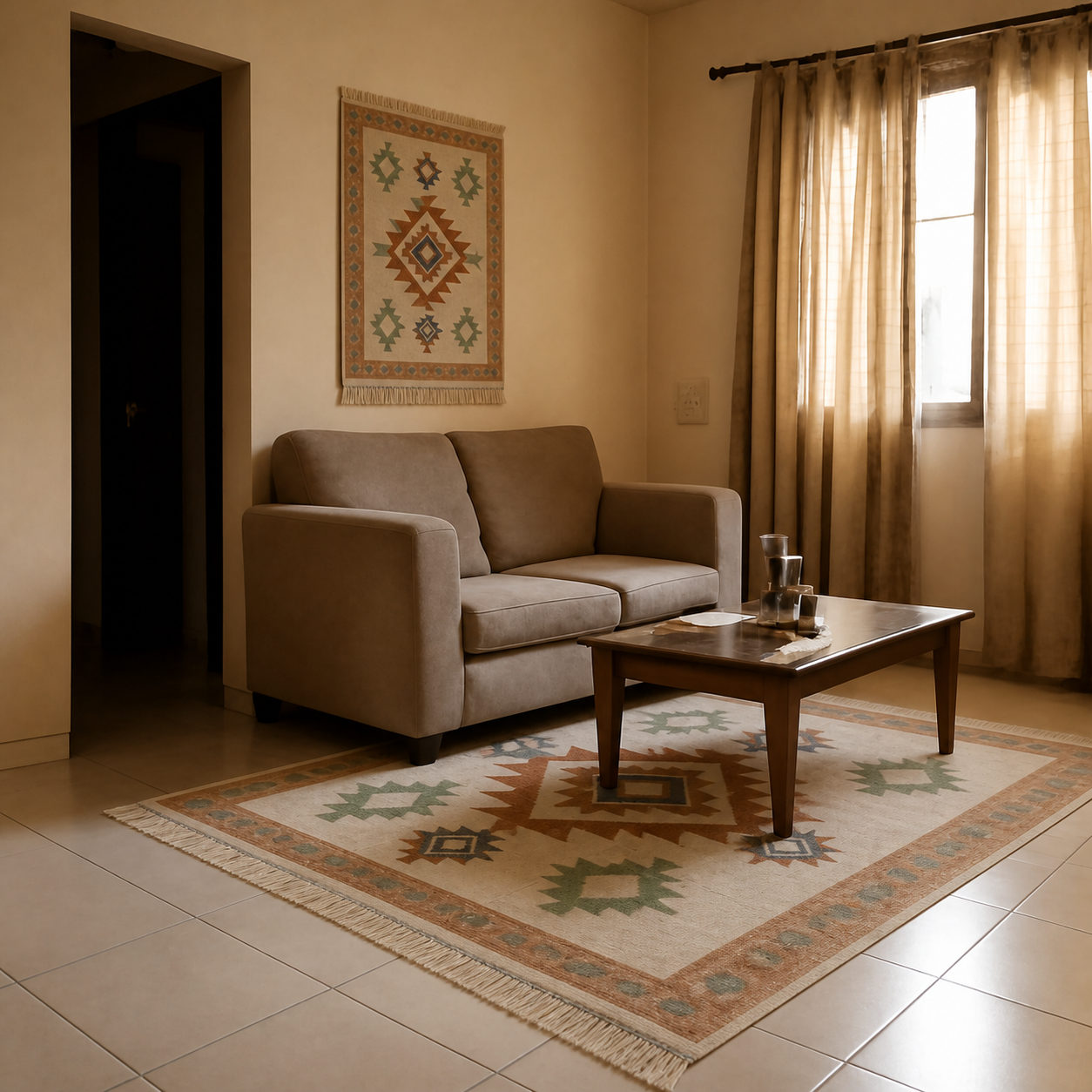
A 5x7 ft rug under a 3-seater sofa anchors the entire living room. Without one, the room reads “not done” even if every other piece is right. At ₹2,500–₹3,500, what to look for:
- Hand-loomed cotton dhurrie or jute, not printed polyester. Printed rugs at this price reveal their print pattern within months as the surface flattens. Woven texture ages better.
- Neutral or single-accent palette. A busy multi-colour rug fights every cushion and curtain you own. Stick to one dominant tone.
- 5x7 ft for a 12x14 ft room, 6x9 ft for 14x16. Indian living rooms over-index on undersized rugs. The front legs of the sofa should sit on the rug.
- Backed, not loose-woven. Anti-slip latex backing is worth the extra ₹200 — loose dhurries shift on tile floors and curl at the corners.
Before committing, see how the colour reads against your wall and flooring — the same rug shop image looks completely different against grey tiles than against wooden flooring. The rug living room demo and the rug visualizer show the kind of preview you can get from a listing image.
The statement mirror — sizing matters more than style
A 36-inch round mirror in the ₹1,800–₹2,800 range is the single most space-amplifying purchase on this list. The mistakes to avoid:
- Too small for the wall. A 24-inch mirror on a 10-foot wall reads as a postage stamp. The mirror should be at least one-third the width of the wall it sits on.
- Placed where it reflects the ceiling fan. A mirror hung too high stares at the ceiling. Centre it at eye level — roughly 5 feet 4 inches from the floor.
- Plastic frames that look like metal in the listing. A telltale sign in customer photos: glare-finish frames in the stylist shot, matte plastic in the real buyer's.
- Bevelled glass over plain. A small bevel at the edge costs ₹100 more and reads dramatically more premium in a real room.
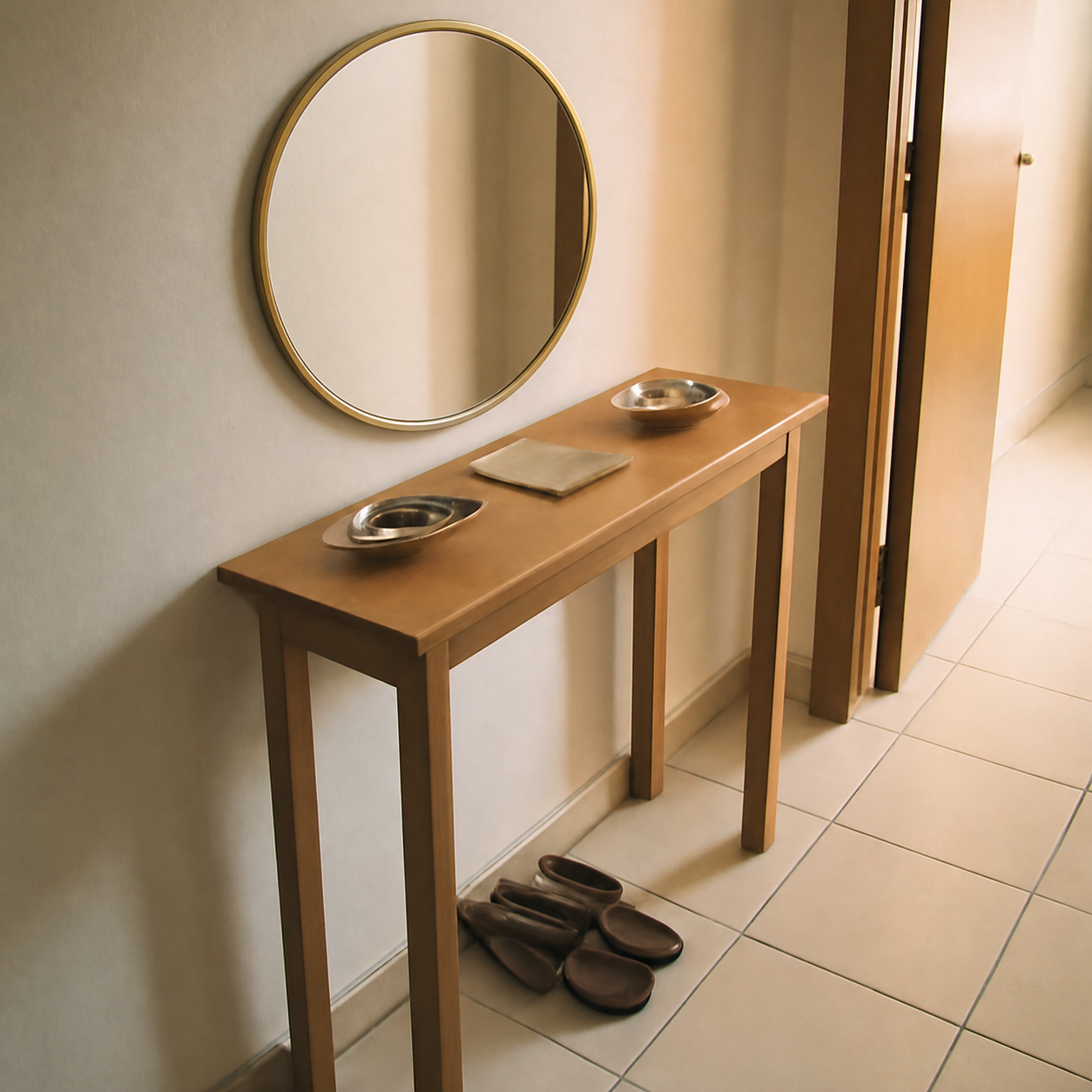
See the mirror entryway demo and the mirror visualizer for how a single piece reads against a real wall.
Lamps — replacing one tubelight changes the room
Most Indian living rooms have exactly one light source — an overhead tubelight at 4000K daylight. Adding one warm-white ambient lamp at 2700K is the cheapest way the room starts to feel like a curated space rather than an office at 8pm.
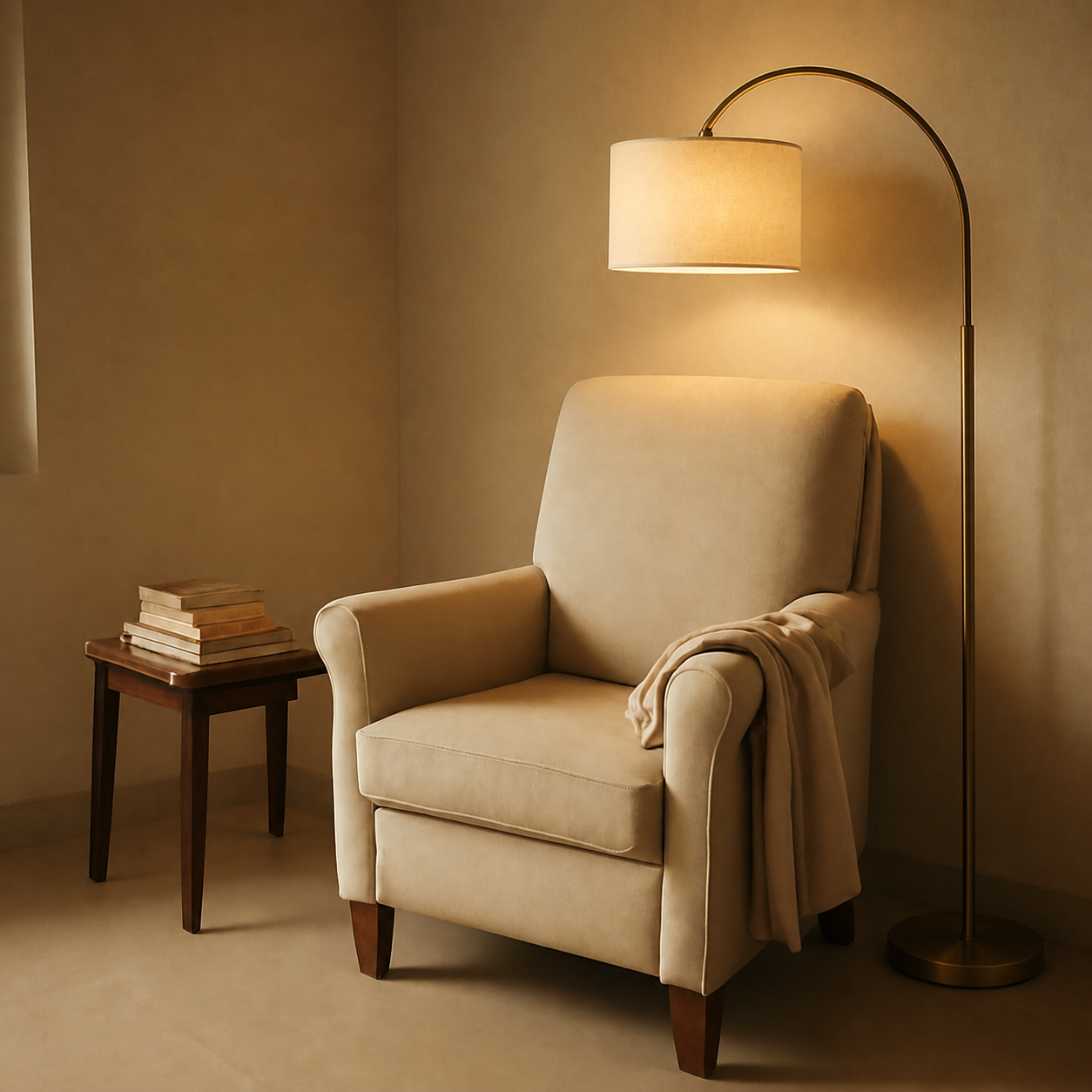
- A tripod floor lamp at ₹1,500–₹1,800. Wooden legs, fabric shade. Tucks into a corner next to the sofa. Reads warmer in evening photos than any pendant or ceiling light.
- A table lamp pair at ₹600 each. Either side of a console table. Reads symmetric and intentional even on a budget.
- A 2700K warm-white bulb, not the included 6500K. Most Amazon lamps ship with a cool-daylight LED. Swap it for ₹150.
See the floor lamp demo for how a single lamp changes the read of an evening living room, and the lamp visualizer to compare shapes before committing.
Planters, art prints, and the cheap finishers
The last ₹2,500 goes the furthest if you spend it on small, layered pieces rather than one mid-sized statement.
| Piece | Price band | Why it works |
|---|---|---|
| Three terracotta planters | ₹900–₹1,400 | Mixed heights read curated; matching reads like a hotel |
| Trio of A4 art prints | ₹400–₹600 | Unframed prints + ₹200 frames beat one ₹1,200 framed print |
| Set of two cushion covers | ₹500–₹800 | Tonal pair, not matching — one texture, one accent |
| A warm-white copper-wire fairy light | ₹250–₹400 | Behind a plant or along a railing. Skip RGB. |
How to evaluate an Amazon India listing before you click buy
The platform-specific checks that save you a return cycle:
- Review count threshold. For decor under ₹2,000, treat anything below 500 reviews as unverified. A 4.4 with 1,200 reviews is more reliable than a 4.8 with 60 — the latter is usually inflated by giveaways.
- Sold-by, not just brand name. Click into the seller. Pieces sold by “Cloudtail” (historically) and now by “Appario Retail” or direct-from-brand stores tend to have stricter QC. Random third-party sellers are a coin flip even on the same listing.
- Return policy variation per seller. The same product can be 10-day return with one seller and non-returnable with another. Always check the “return policy” line on the right rail before adding to cart — especially for glass, terracotta, and brass.
- Pay-on-Delivery vs prepaid. For sellers you don't know, COD is the trust signal — if a seller offers it, you can inspect the parcel before paying. For larger pieces, the carton has to be opened in front of the delivery agent, which most agents will allow for COD orders.
- Buyer photos vs stylist photos. Scroll past the listing carousel and into the customer photo grid. If buyer photos look noticeably duller, smaller, or plasticky compared to the brand shots, you know which version shows up in your cart.
- Dimensions in centimetres, not just inches. Indian sellers sometimes list inches that turn out to be centimetres, or vice versa. A 36-cm “mirror” is smaller than a steering wheel.
Preview before you buy — the habit that saves the ₹10,000
The fastest way to waste a ₹10,000 refresh is to order six pieces that each looked great in the listing and end up clashing in your living room. The rug fights the curtains, the mirror is too small for the wall, the lamp's shade is beige in the photo and yellow in person.
Drop the Amazon India product image — or the product URL — into a photo of your actual living room before clicking buy. PlopIt places the exact piece into your space at correct scale and lighting. It's free, no signup, and the preview takes about a minute per item.
For deeper coverage, the small Indian apartment guide covers the design principles, the 1BHK-feel-bigger post covers compact-living tactics, and the ₹5,000 budget guide is the half-budget version of this one. The Amazon-furniture preview workflow explains how to grab a product image from a listing in one step.
What to skip even at ₹10,000
- “Home decor combo” bundles. The 12-piece kits at ₹2,499 are almost always one material painted to look like another. They photograph as set pieces and read as plastic in person.
- Floor-standing artificial plants. The ₹1,200 fake fiddle-leaf fig is the most-returned plant category. A ₹150 real money plant in a terracotta pot beats it every time.
- Mass-produced abstract canvases. The thick-paint stretched canvases under ₹800 look fine in the listing and dated on a real wall within a year.
- Buying everything in one cart. Spread the order over two days. The second day's parcels give you a chance to course-correct after the first arrive.
Quick ₹10,000 checklist
- 1Pick five of the six categories. Skip the one you already have a passable version of.
- 2Preview each piece in a photo of your actual living room before adding to cart.
- 3Check review count (≥500), seller name, and return policy on every item over ₹1,000.
- 4Order across two days, not one — let the first batch land before placing the second.
- 5Choose COD for unfamiliar sellers so you can inspect before paying.
As an Amazon Associate we earn from qualifying purchases.