Indian living rooms today cluster into four style families: modern minimalist (neutral palette, mid-century influence, clean lines), traditional Indian (carved wood, jewel tones, ornate rugs), eclectic Indo-Western (mix-and-match vintage with new), and contemporary (restrained palette, statement art, almost no ornament). Each works at Indian apartment scales — the failure mode is always trying to do two of them on the same wall. The cheapest way to commit is to pick one direction, build a small palette, and preview the big pieces in your actual room before ordering.
Four styles at a glance
| Style | Palette | Signature | Works in |
|---|---|---|---|
| Modern minimalist | Greige, ivory, oak, sage | Tapered legs, slim profiles | 1BHK and small 2BHK |
| Traditional Indian | Maroon, mustard, indigo, brass | Carved teak, dhurries, brass | Large 2BHK, 3BHK, bungalow |
| Eclectic Indo-Western | Mixed neutrals with a saturated accent | Vintage + new, layered textiles | Older 2BHK, heritage flats |
| Contemporary | Charcoal, off-white, walnut, one accent | Statement art, restrained palette | New-build apartments |
Modern minimalist — the apartment-friendly default
Mid-century-influenced furniture with Indian-scale proportions. The dominant style in new metro apartments because every piece is sized to fit through a 32-inch door and around a 1BHK hallway turn.
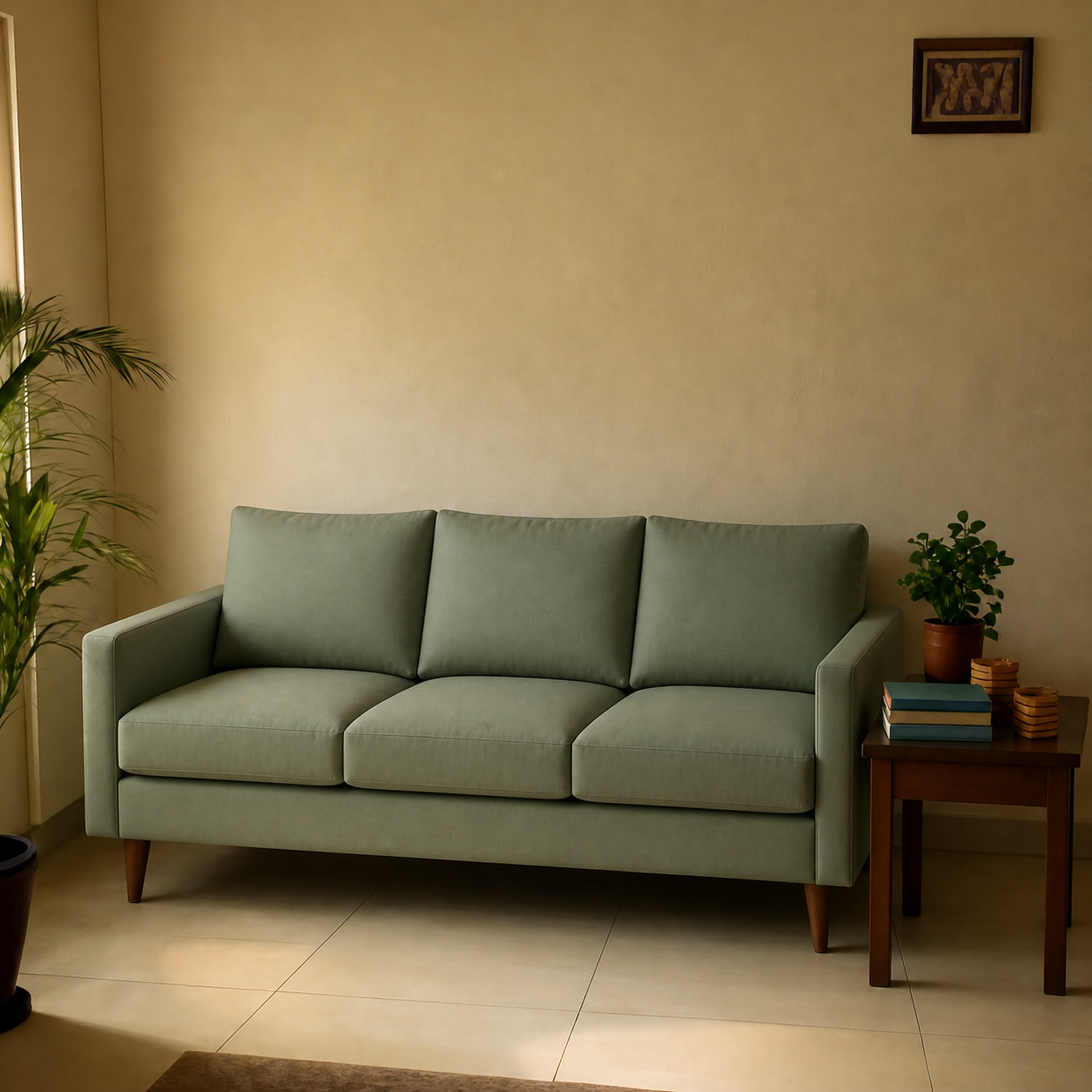
- Signature pieces. A 72-inch 3-seater sofa with tapered wooden legs, a 5x7 ft jute or hand-loomed rug, a 36-inch round mirror, one tripod floor lamp, two ceramic planters.
- Palette. Greige walls, off-white upholstery, light-oak wood, one tonal accent (sage, terracotta, dusty rose). No more than three colour families in the entire room.
- Common mistake. Buying a “modern” sofa with chrome legs and high-gloss black upholstery. That's 2010s showroom, not modern minimalist.
- Budget. ₹40,000–₹80,000 for a full living room refresh, depending on whether the sofa is local or D2C.
See the sofa living room demo for how a typical mid-century-influenced sofa reads at Indian apartment scale.
Traditional Indian — for the room that has space
Carved teak or rosewood, jewel tones, brass accents, dhurries or hand-knotted carpets, and Madhubani or Tanjore art. Looks stately in a 200 sqft living room and overwhelming in a 100 sqft one — the style consumes visual space.
- Signature pieces. A carved teak sofa with brocade or velvet cushions, a hand- knotted Kashmiri or Mirzapur rug, brass urli on the coffee table, a jharokha mirror, a swing or hand-painted wooden chest as accent furniture.
- Palette. Deep maroon, mustard, indigo, emerald, contrasted against cream walls. Brass and dark wood as the metals and woods.
- Common mistakes. Mixing carved teak with white modular cabinetry, putting a glass dining table in front of a brocade sofa, hanging a minimalist abstract print on a hand-painted feature wall. Pick one direction and commit.
- Budget. ₹80,000–₹2,00,000 because the wood and the rug carry the weight. Cheaping out on either is visible immediately.
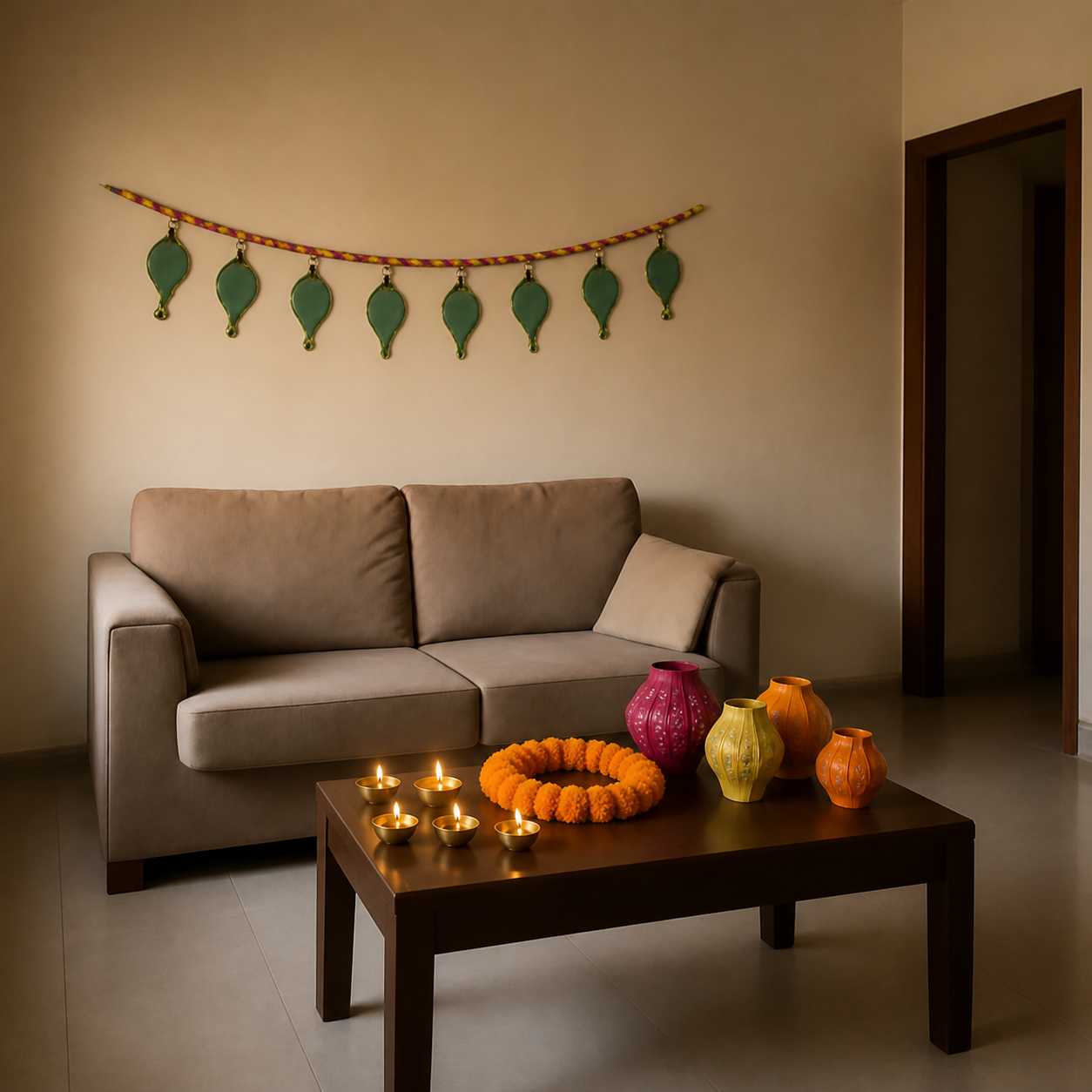
For the seasonal version of this style, see the Diwali living room demo and the Diwali budget guide.
Eclectic Indo-Western — disciplined mixing
The hardest style to pull off and the most rewarding when it works. The trap: people read “eclectic” as “anything goes,” buy one piece from every other style on this list, and end up with a furniture warehouse, not a living room.
- Signature pieces. A vintage rosewood chair next to a modern fabric sofa, a 1960s-style brass lamp on an IKEA-style side table, a kantha quilt thrown over a Pottery Barn-style ottoman, framed family photos next to abstract prints.
- The rule that keeps it from looking chaotic. One repeating colour across every piece, even if the materials and eras differ. Often it's a warm brown, a deep mustard, or a muted teal. The eye tracks the colour, not the variety.
- One statement piece per category. One bold rug, one statement sofa, one accent chair, one striking artwork. Not three of each.
- Common mistakes. Mixing five wood tones, treating every wall as a feature wall, layering rugs over carpet over tile, hanging gallery walls on every empty surface.
- Budget. Variable. Eclectic forgives budget because half the pieces can be heirlooms or thrifted; the modern pieces carry the price.
The eclectic style benefits the most from a preview check before each purchase. See the design-around-one-statement post for the discipline that makes eclectic work.
Contemporary — restraint as the design move
Contemporary Indian living rooms read closer to a gallery than a home: large blocks of single colours, one or two oversized pieces of art, almost no decorative objects on surfaces, and clean horizontal lines.
- Signature pieces. A deep low-back sofa in charcoal, slate, or oatmeal; a large minimalist artwork (often a single-colour canvas or photography); a slab coffee table in marble, walnut, or travertine; one sculptural lamp; no clutter on any surface.
- Palette. Two dominant neutrals (off-white + charcoal, or oatmeal + walnut) plus one accent colour used sparingly (rust, deep green, ochre).
- Common mistakes. Buying contemporary pieces but cluttering them with traditional decor (brass urli on a marble slab table reads like the room can't decide what it is). Picking a colour palette that's all cool tones in a yellow-tube- lit Indian flat.
- Budget. The most expensive of the four to do well because the minimalism makes every individual piece visible. A cheap sofa is hidden by accessories in eclectic; in contemporary it's the only thing in the room.
How to pick a style for your space
Three questions, in order:
- 1How big is the room? Under 150 sqft → minimalist or contemporary. 150–250 sqft → any of the four works. Above 250 sqft → traditional and contemporary read best because they have room to breathe.
- 2Do you own heirloom or vintage pieces? If yes, eclectic or traditional is the path of least resistance. Trying to do modern minimalist around an inherited rosewood chest is a fight you'll lose.
- 3How much natural light does the room get? Dark or north-facing rooms suit traditional or eclectic (the warm palette compensates). Bright south- or east-facing rooms can hold contemporary or minimalist.
Nailing any of the four on a budget
Each style has a cheap-mistake equivalent that ruins the look. The fixes:
| Style | Don't cheap out on | OK to economise on |
|---|---|---|
| Modern minimalist | Sofa, rug, one lamp | Cushions, art prints, planters |
| Traditional Indian | Wood furniture, rug, brass | Cushion covers, photo frames |
| Eclectic Indo-Western | One statement piece, the rug | Everything else can be thrifted |
| Contemporary | Sofa, art, coffee table | Lighting, side tables |
Preview every big piece before committing to a style
The single most expensive mistake is committing to a style based on a Pinterest board and discovering that the same sofa reads totally different against your specific wall colour and floor. A traditional carved-teak sofa against grey vitrified tiles looks displaced; the same sofa against wooden flooring looks like a Connaught Place heritage living room.
Drop the product image into a photo of your actual living room before ordering. PlopIt places the piece at correct scale and lighting, so you can see whether the style will land before you commit. For the apartment-scale principles, the small Indian apartment guide is the companion piece, and the 1BHK-feel-bigger post explains the visual tactics that work at every style.
For the budget Amazon-shopping version of any of these styles, the ₹10,000 budget guide walks through the categories that work for under ten thousand.
Quick style-picker checklist
- 1Measure the living room. Anything under 150 sqft pushes you toward minimalist or contemporary.
- 2List the heirloom or vintage pieces you're not throwing out. They decide whether eclectic or traditional is the obvious path.
- 3Pick one palette and stick to three colour families across the whole room.
- 4Preview the sofa and rug in a photo of your room before any other purchase.
- 5Commit to one style. Mixing two on the same wall is the most common reason a room never quite lands.