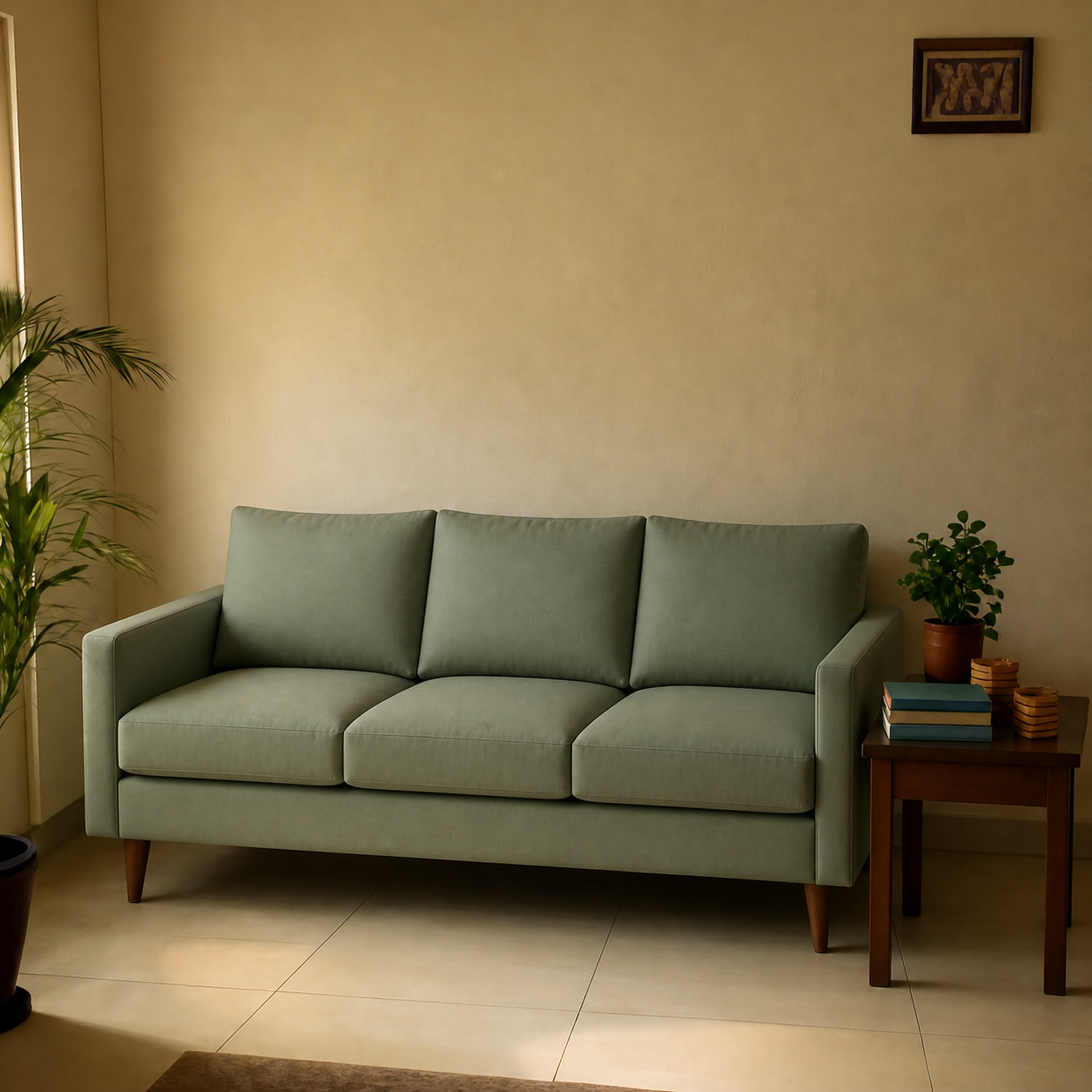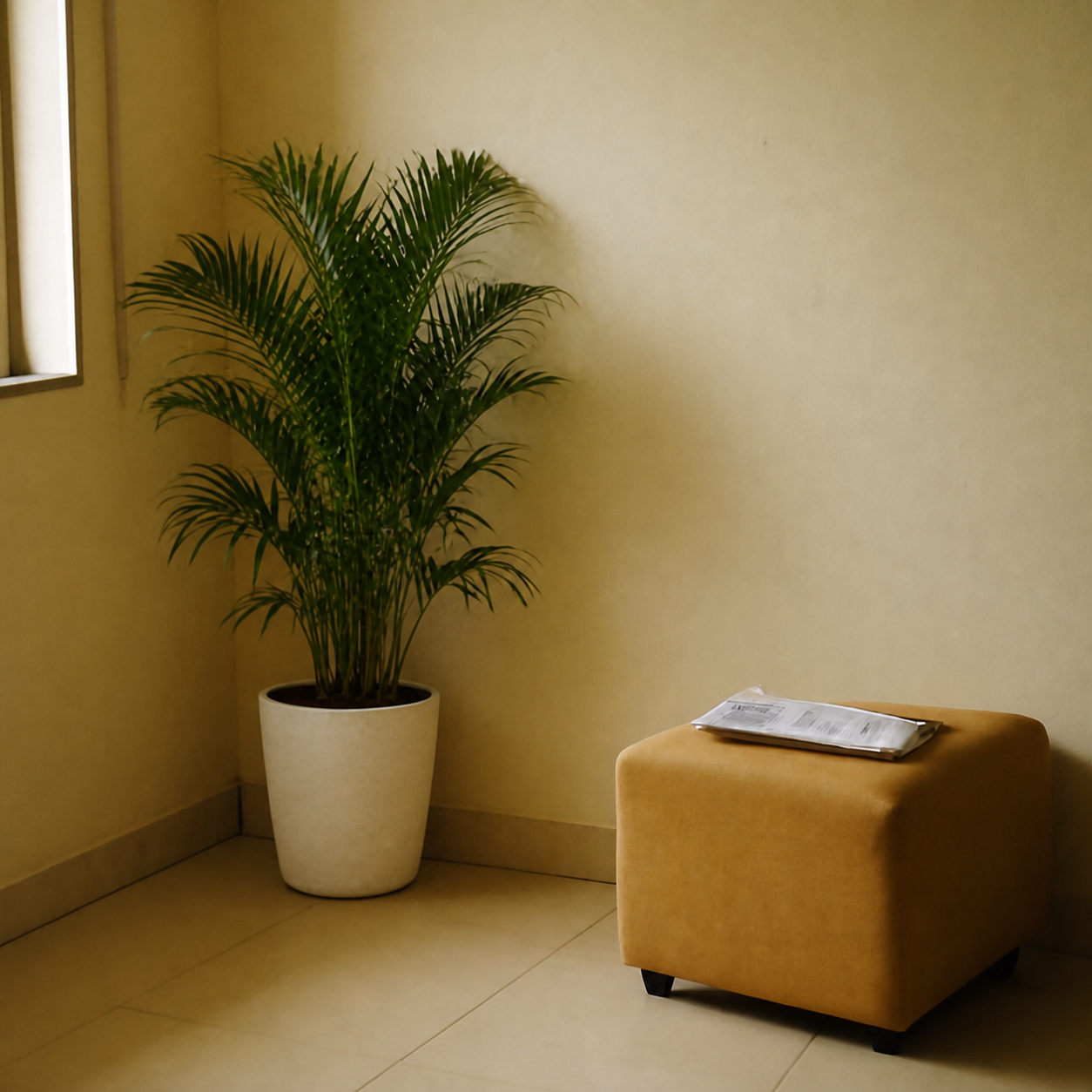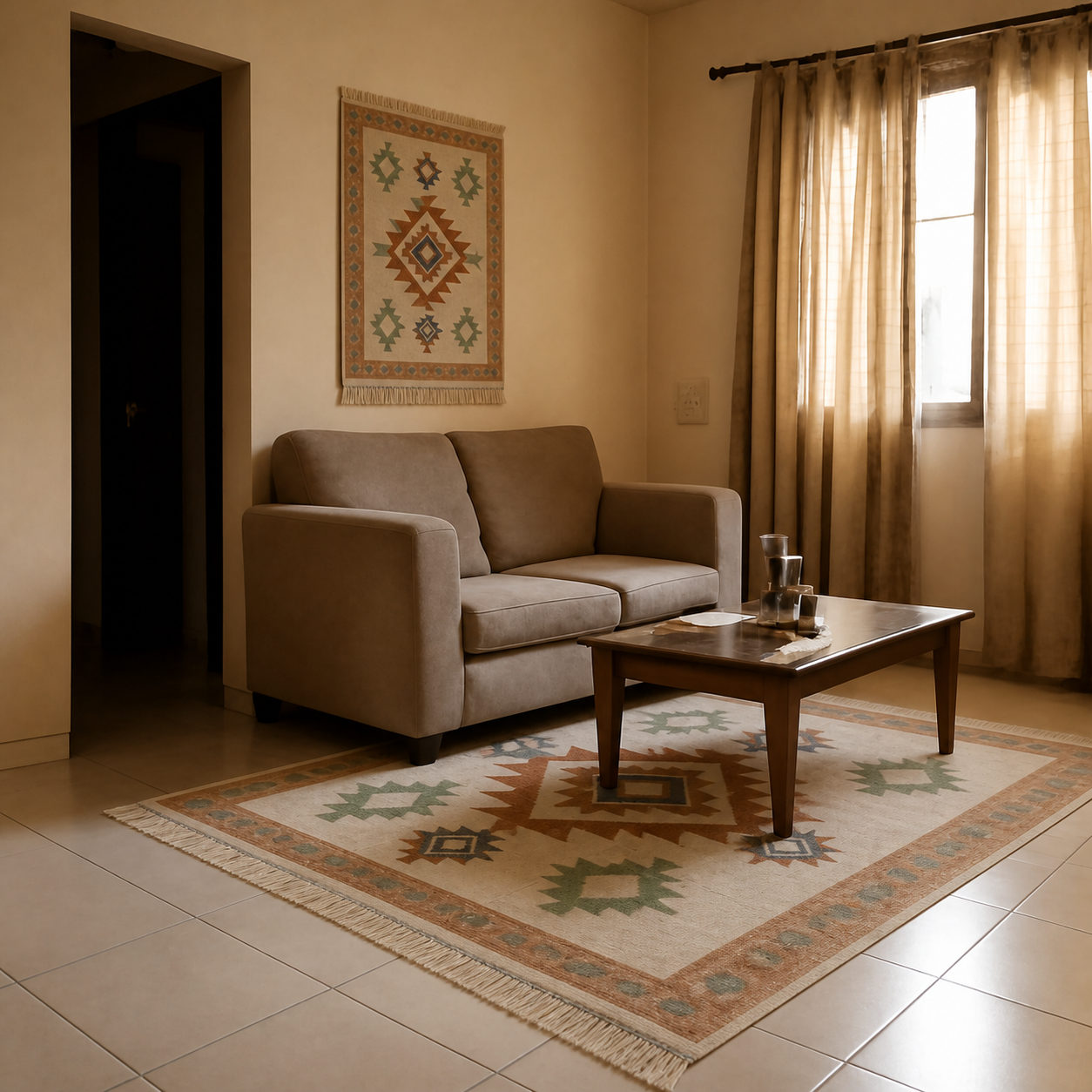
Planning a budget room makeover works best when you allocate the money before you start spending: 60% on the one statement piece (usually a sofa, bed, or rug), 25% on supporting cast (lamps, cushions, side tables), 15% on accents (art, plants, throws). Reuse what you have aggressively. And preview every piece in a photo of your actual room before clicking buy — return cycles eat budgets faster than any single overspend.
The 60-25-15 budget split
The most common budget mistake is spending evenly across every category. The result: nothing in the room reads like a centerpiece, and the room still looks unfinished. A weighted split fixes this.
| Bucket | Share of budget | Typical pieces |
|---|---|---|
| Statement piece | 60% | Sofa, bed, large rug, dining table |
| Supporting cast | 25% | Lamps, side tables, cushions, curtains |
| Accents | 15% | Art, plants, throws, candles, small decor |
Worked example for a ₹50,000 living-room makeover: ₹30,000 on the sofa, ₹12,500 across lamps + curtains + cushion covers, ₹7,500 on art + plants + a throw. For $1,000: $600 on the sofa, $250 on supporting, $150 on accents.
Step 1 — Audit what you already own
The cheapest furniture is the furniture you already have. Before ordering anything new, look hard at every existing piece and put it into one of three buckets:
- Keep as-is. Good piece, fits the new direction, no work needed.
- Refurbish. Solid frame, dated finish. A wooden coffee table can be sanded and re-stained for ₹500. A sofa with a tired fabric can take new cushion covers and a throw for ₹2,000 total and look entirely different.
- Replace. Broken, unsalvageable, or fundamentally wrong for the new direction. Sell on OLX before buying replacement — even a ₹500 resale offsets a piece of the new budget.
Roughly two-thirds of the average makeover involves furniture that gets thrown away when it could have been refurbished. Be honest about which bucket each piece is actually in.
Step 2 — Pick a direction, write it down
Most budget overruns happen because of style drift — you order a Scandinavian-look sofa one week and a Rajasthani-style mirror the next, then have to buy a third thing to bridge them. Commit to one direction up front.
- Three adjectives. Write the room down in three adjectives. “Warm, simple, brass-accented.” Every purchase has to pass the three-adjective test.
- One reference photo. Save one Pinterest or Instagram image that captures the direction. When tempted by something off-brief, compare side by side.
- A colour palette of three to four. One neutral base, one secondary neutral, one accent. That's it. The accent can repeat in cushions, art, and one supporting piece.
Step 3 — Spend the 60% well
The statement piece is where budget mistakes are most expensive — and where previewing pays back the most. Three checks before ordering:
- 1Does it physically fit? Doorway, stairwell, elevator. See the sofa-fit guide for the diagonal checks people forget.
- 2Does it visually fit? Scale against the room, colour against the wall, depth against the walkway. A photo preview catches all three in under a minute.
- 3Will it still look right in five years? Statement pieces are the longest-lived. Trends in 2026 — boucle everything, deep-seat lounge sofas, terrazzo prints — won't look fresh in 2030.
For the visual fit, drop the product image into a photo of your actual room. The sofa living room demo shows what an accurate preview looks like at correct scale and lighting.
Step 4 — Supporting cast: where to splurge and where to save
The 25% bucket is the easiest to overspend in because each individual item is cheap. The trap is buying eight items that all look fine alone and add up to a busy room.
| Category | Spend on | Save on |
|---|---|---|
| Lighting | One quality floor lamp, warm bulb | String/fairy lights, accent lamps |
| Cushions | Linen or cotton-velvet covers | Cushion inserts (any brand works) |
| Curtains | Linen, cotton, or blackout liner | The rod itself (basic chrome is fine) |
| Side tables | A solid-wood or marble-top piece | Set-of-two metal nesting tables |
See the lamp visualizer and curtain visualizer for the kind of difference a single supporting-cast piece makes against the rest of the room.
Step 5 — Accents last, not first
Most makeovers start with accents — a Pinterest-board moodboard of vases, candles, and prints — and run out of money before the sofa. Reverse the order. Buy accents only after the statement piece and supporting cast are in the room.
Accents that consistently outperform their price:
- One large piece of art. A single 20x30 inch print beats three 12x16 inch ones on the same wall. Easier to place, more impact.
- One real plant in a real pot. A snake plant or fiddle-leaf fig in a terracotta or stoneware pot. The plant corner demo shows how a 5-foot plant anchors a corner.
- One textured throw across the sofa arm. A chunky-knit or jacquard throw is the cheapest way to add warmth.
- A single brass or ceramic vase on the coffee table. One piece, not three. The cluster-of-vases look reads like showroom display.
Preview as the cost-saving habit
Return cycles are the silent budget killer. A piece arrives, it doesn't work, it goes back, return shipping costs ₹500 to ₹1,500 per item, restocking fees take another 10–15%, and now you've paid 20% of the original price for something that's not in your home. Two return cycles can eat the entire accents budget.
The fix is to preview before clicking buy. Drop the product image from any retailer — Pepperfry, Urban Ladder, Amazon, Wayfair, IKEA — into a photo of your actual room. PlopIt places the exact piece at correct scale and lighting.
For more on why returns are so expensive, see why furniture returns are expensive and how often people return furniture online — the rates are higher than most shoppers realize.
A 30-day makeover timeline
Stretching a makeover over a month avoids the rushed-purchase cycle that drives returns. A practical sequence:
- 1Days 1–3: Audit what you have. Sell or donate. Write the three adjectives and pick a reference photo.
- 2Days 4–10: Shortlist the statement piece. Preview the top 2-3 candidates in your actual room. Order.
- 3Days 11–18: Wait for the statement piece to arrive. Live with it for a few days before buying supporting cast.
- 4Days 19–25: Shop for supporting cast. Preview against the new statement piece. Order.
- 5Days 26–30: Accents last. Walk a Sunday flea market or local shop with the room in mind, not the other way round.
Common budget-makeover mistakes
- Buying everything in one weekend. The pieces don't talk to each other yet. Stretch over three to four weeks so you can adjust as each piece arrives.
- Mixing high-end and ultra-cheap finishes. A ₹40,000 sofa next to a ₹500 plastic side table reads worse than a ₹25,000 sofa next to a ₹2,000 wooden side table.
- Skipping the audit step. The most expensive piece in any makeover is the one you already owned and replaced because you didn't see it differently.
- Not pre-measuring delivery paths. A ₹30,000 sofa stuck on a stairwell landing is the worst kind of budget overrun.
- Skipping the preview step. Ten seconds of previewing a piece in a photo of your room prevents most of the issues that drive returns. It is the single highest-ROI habit in budget-makeover work.
For Indian apartments specifically, the small-apartment guide and the 1BHK-feel-bigger post cover the constraints that shape what budget actually buys you at each price point.